Article length: about 4,600 characters. Estimated reading time: about 15 minutes.
Introduction: In 2018, Run Kakada of Ba Rang Village in Battambang Province left home to work as a cleaner at an apartment building in Pattaya, Thailand. He earned about 500 U.S. dollars a month, and his employer also provided accommodation and motorcycle insurance. At home were his elderly mother and a nephew who had lost both parents.[1]
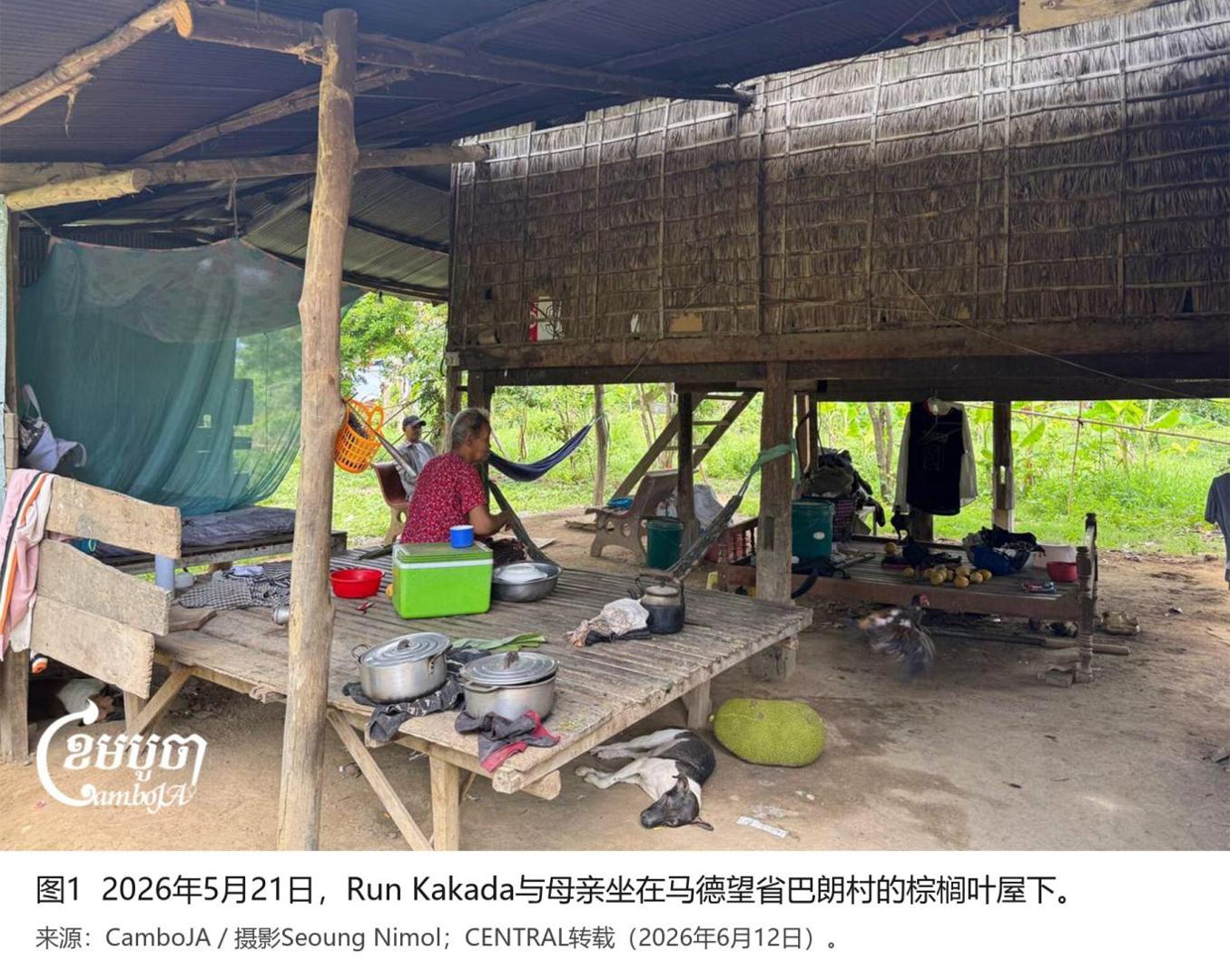
In 2025, tensions on the Cambodia-Thailand border rose sharply, and he returned to Cambodia along with nearly one million compatriots. "Coming back to Cambodia felt like starting everything from zero," he said. When a local journalist met him in Ba Rang Village on May 21 this year, he was sitting with his mother under their home, which is built of palm leaves.[1]
More than a year later, the question facing returnees like Kakada is no longer "Can I find a job?" but "Can I settle down?" On November 18-19, the International Labour Organization (ILO) held a thematic discussion in Geneva on this large-scale return. The discussion drew on Working Paper No. 179, which estimates that 820,000 to 950,000 workers returned home in 2025. That is close to one-tenth of Cambodia's labour force.[2,3]
This article follows Kakada and several other returnees and draws on official data and the state's concrete actions to answer three questions: how the state is absorbing these workers, how returnees can make themselves more competitive, and whether Preah Sihanouk Province can become an important destination for them.
An Unprecedented Return Flow
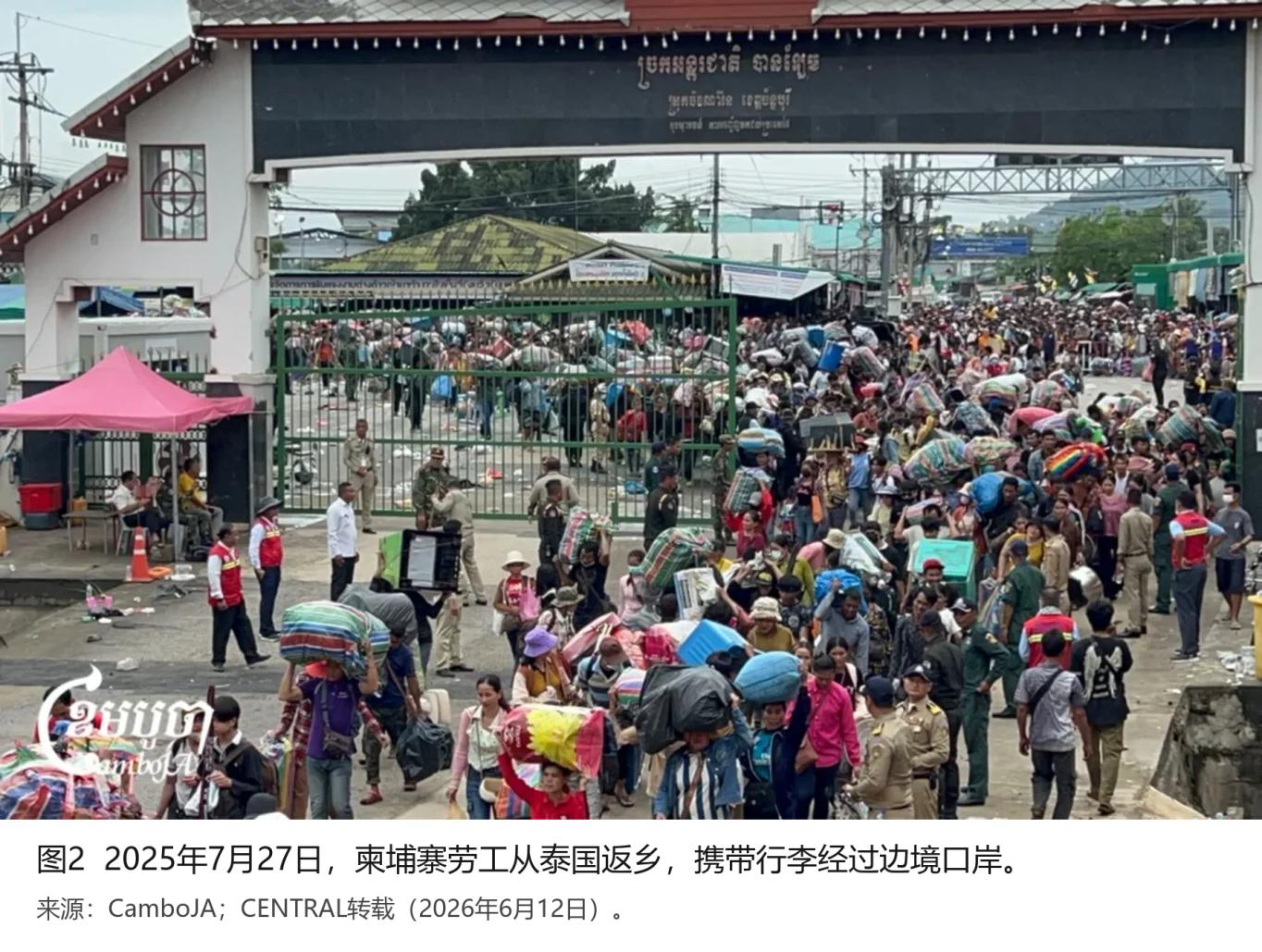
In Kakada's village of Ba Rang, about 30 percent of its 500 households are former migrant workers. Nationwide, this return is far larger than anything before it. During the COVID-19 pandemic, more than 265,000 Cambodian migrants returned from Thailand. This time, the number is more than three times that figure.[1,4]
Nor is this a short-term retreat from danger. A progress report by the Ministry of Labour and Vocational Training shows that from May 2025 to April 10, 2026, about 770,000 returnees stayed in the country to live and work.[5]
Household finances felt the impact first. Data from the National Bank of Cambodia show that remittances nationwide totaled about 2.1 billion U.S. dollars in 2025, down 23.6 percent from the previous year. Remittances from Thailand fell 27 percent. Over the same period, the World Bank projected that Cambodia's poverty rate could rise by about 1 percentage point in the short term.[6,7,8]
Because the return is so large, so lasting and so direct in its impact, resettlement cannot be just an emergency response. It must be a long-term undertaking.
The State Steps In: Three Steps to Absorb Returnees
Faced with the return of nearly one million people, the Cambodian government's response can be summed up in three steps: bring them back, get them into jobs, and make them stay.
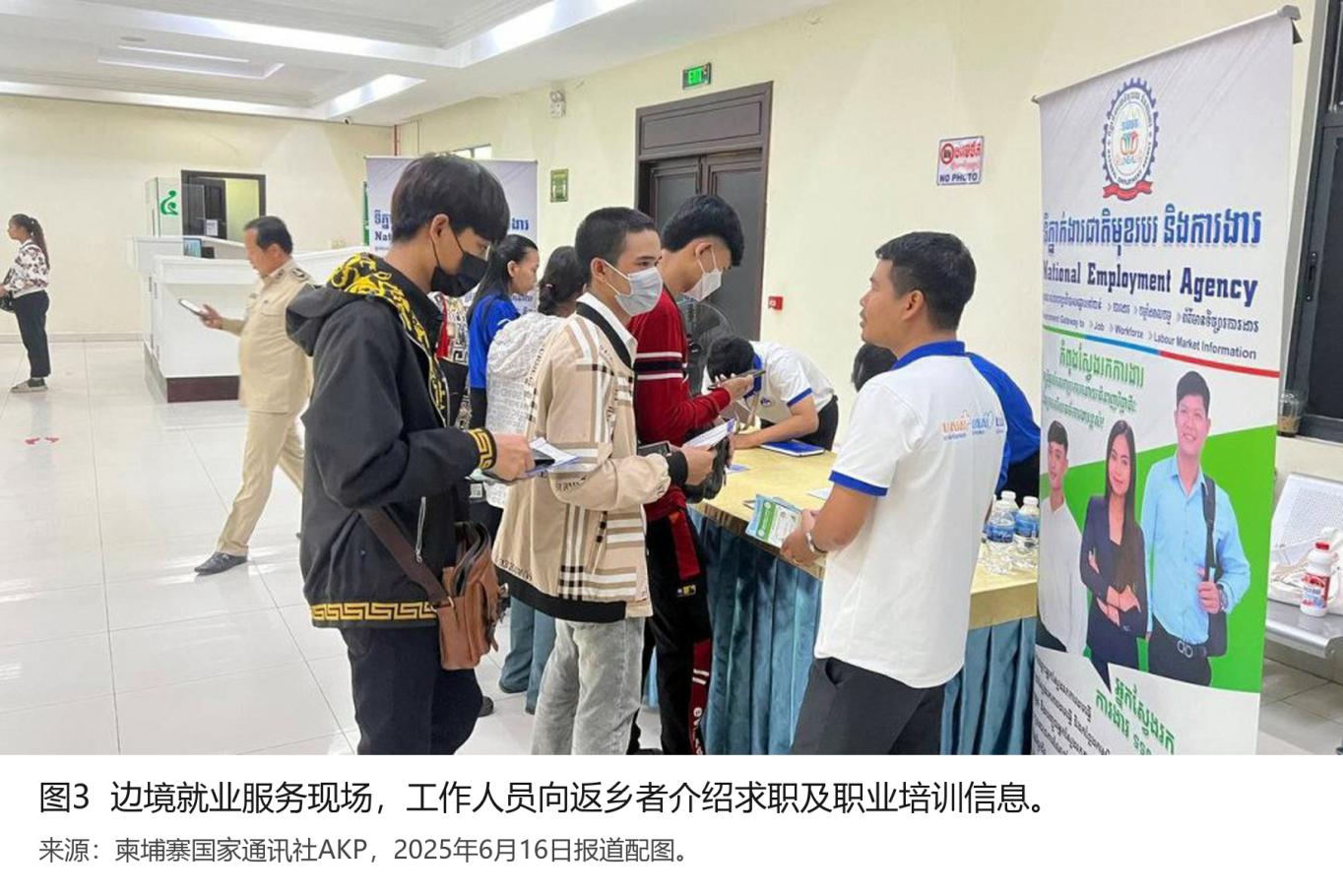
Bringing them back. Starting June 16, 2025, officials of the Ministry of Labour and Vocational Training were posted at checkpoints along the Cambodia-Thailand border. They set up mobile employment service centers and handed returnees job information sheets listing factory names, locations and contact numbers. Prime Minister Hun Manet called on the banking association and the microfinance association to ease the loan repayment burden on returning workers. The Ministry of Economy and Finance announced cash assistance for returnees holding poor-household cards. It also opened free technical and vocational training, with trainees receiving an allowance of 280,000 riels (about 70 U.S. dollars) per month.[9,10,11,12]
Getting them into jobs. In August 2025, the Ministry of Labour and Vocational Training posted more than 110,000 job vacancies, and more than 60,000 people found work within 10 days. Of the more than 87,000 people who attended job fairs, 16,800 were hired on the spot. The ministry then launched the 1297 job-seeking hotline and held more than 600 employment forums and more than 1,000 mobile job fairs across the country. By April 2026, about 340,000 people had entered formal jobs through this system. Another 310,000 or so had returned to agriculture, handicrafts, small businesses and similar work.[5,12,13]
Making them stay. On April 24, 2026, the Ministry of Labour and Vocational Training and the National Employment Agency launched Recognition of Prior Learning, which certifies skills that returnees acquired abroad against national standards. So far, 10,000 people have received certificates. In February of the same year, Japan provided 1 million U.S. dollars to launch a 24-month project with the Ministry of Labour and Vocational Training and the ILO. The project plans to help about 20,000 returnees and to build new migrant worker resource centers in Oddar Meanchey, Pursat and Preah Vihear provinces.[14,15,19]

After returning, Kakada also registered with a government employment program and eventually received a job offer. He turned it down, and the reasons are the three challenges discussed below.[1]
Beyond Employment: Three Remaining Challenges
The speed of resettlement shows the state's capacity to mobilize. However, the ILO paper cautions that even if overall employment figures change little, returnees may still suffer significant losses in their livelihoods because of barriers to formal employment. Kakada's experience lays these barriers out one by one.[3]
The first is location. The job Kakada was offered was on a banana plantation in a remote northeastern province, far from the mother and nephew he needs to care for. "If I were on my own, I would go," he said. "But now I have an elderly mother and a nephew who has lost both parents." His case is not unusual. The ILO paper shows that more than 70 percent of returnees went back to provinces bordering Thailand, while most of the roughly 190,000 vacancies counted by the Ministry of Labour and Vocational Training in mid-2025 were around Phnom Penh. The paper estimates that moving between a border province and a city for one year costs about 9 million riels. That equals about seven months of average earnings for an unskilled worker in a formal job.[1,3,32]
The second is income. The plantation job paid only about half of what he earned in Thailand. Minister of Labour and Vocational Training Heng Sour has acknowledged that domestic wages may be slightly lower than in Thailand, but said the state provides free healthcare and pensions. In the garment sector, for example, the minimum monthly wage is 210 U.S. dollars in 2026. It will rise to 212 U.S. dollars in 2027, and with allowances, the actual basic monthly pay will range from 231.5 to 242.5 U.S. dollars. Female workers can also receive 20 U.S. dollars for each prenatal check-up and another 200 U.S. dollars after giving birth.[1,16,17,18]
The third is skills. Kakada cleaned apartments in Pattaya for about seven years, yet nearly a year after returning home, he is still looking for a stable job. More broadly, the ILO paper shows that 89 percent of returnees have no formally recognized skills. The paper's model estimates that about 52 percent of skilled returnees can enter formal employment, compared with only 12 percent of those without skills.[3]
In April this year, after several months of job hunting, Kakada used money from renting out his mother's 500-square-meter rice field to start a small stall selling grilled quail. He usually earns less than 8 U.S. dollars a day, and on slow days only 3 U.S. dollars. Of the three challenges, skills is the one that affects all the others: the 40-percentage-point gap between 52 percent and 12 percent shows how much skills matter.[1,3]
Skills Are the Key to Solving the Problem
Just two months after Kakada's story appeared in the press, on August 11, 2026, the National Employment Agency held a job forum in his home province, Battambang Province. It drew 400 people from Battambang and Pursat provinces, and the 1,000 jobs on offer covered construction, manufacturing, food processing, hotels and other industries.[19]
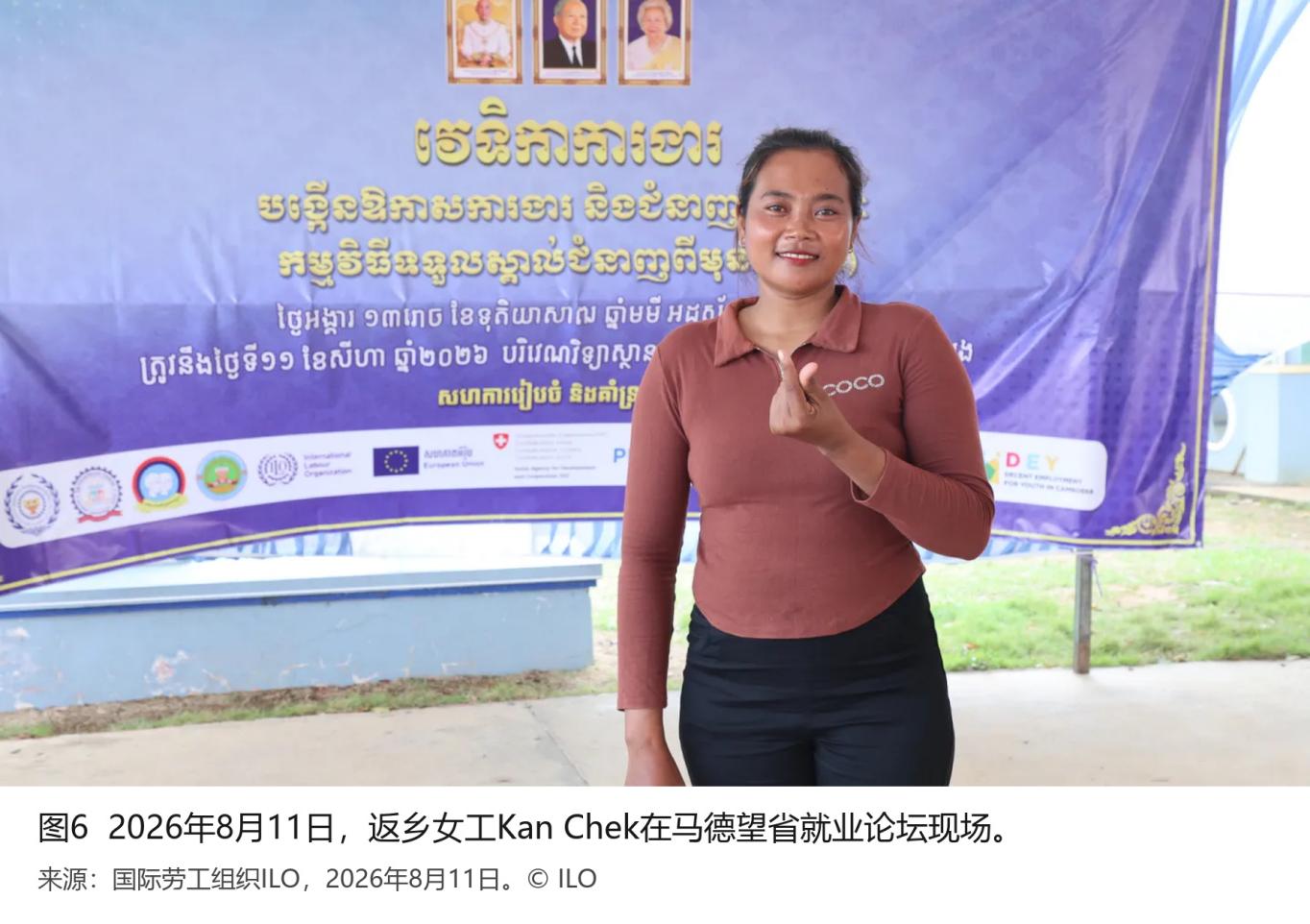
Kan Chek, a woman who had returned from Thailand, was also there. She had learned practical skills in Thailand, but after coming home she worried that without a formal certificate she would not find a suitable job. Her story turned out differently: she took part in Recognition of Prior Learning, and her skills received national recognition. She said this made her "more confident," and at the forum she met employers face to face.[19]
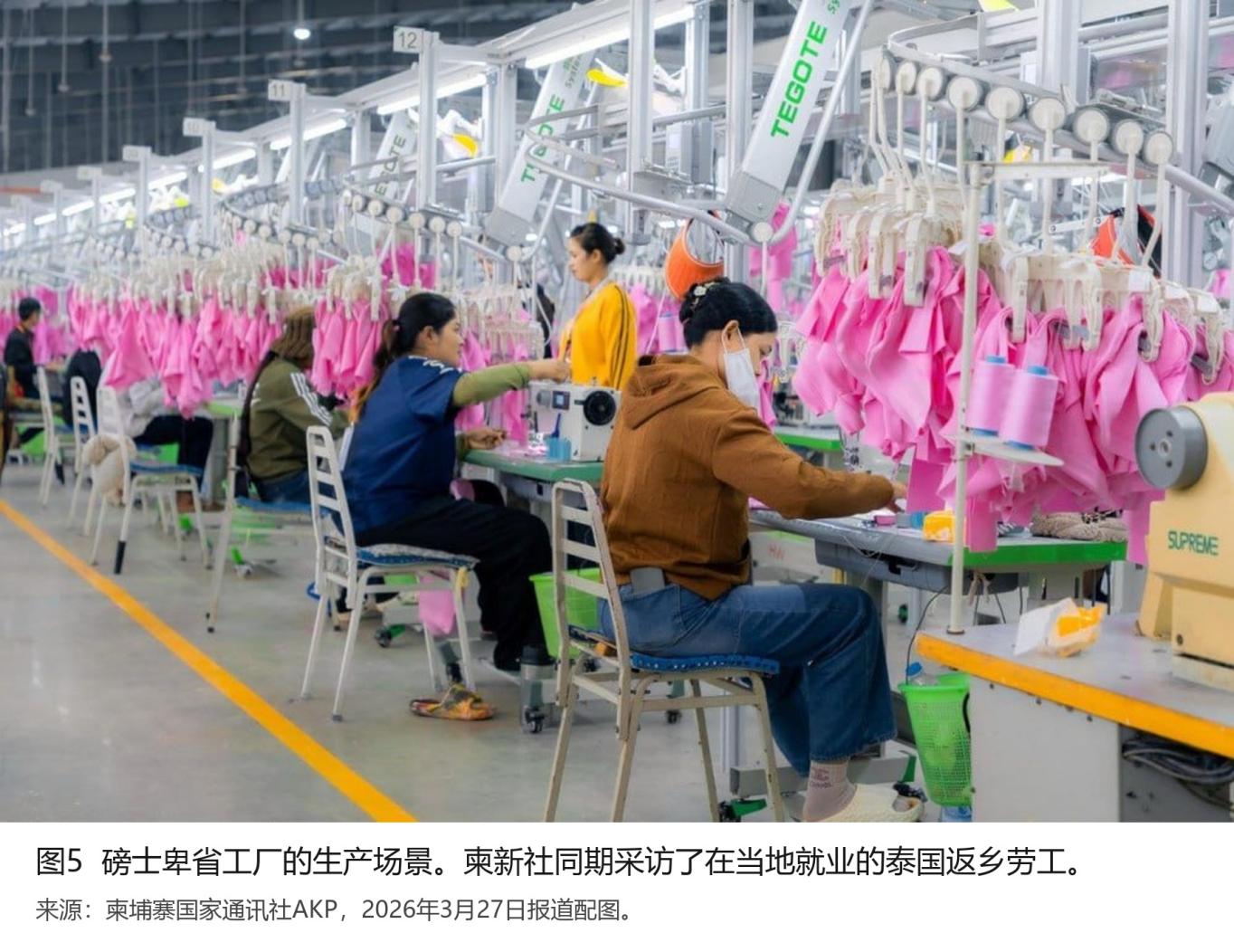
Another returnee, Chok Kunthea, had an easier path. In Thailand she often heard rumors that "there are no jobs back home," yet she received a job offer right at the border and now works at T.S. Sport in Kampong Speu. "I didn't expect it to go so smoothly," she said. She is now encouraging her relatives to come home and work with her.[13]
All three came home, but each took a different path. What set them apart was not how hard they worked. It came down to three things: whether they had recognized skills, whether there were jobs near home, and whether they could reach channels that matched them with employers. For returnees, all three already have ready entry points:
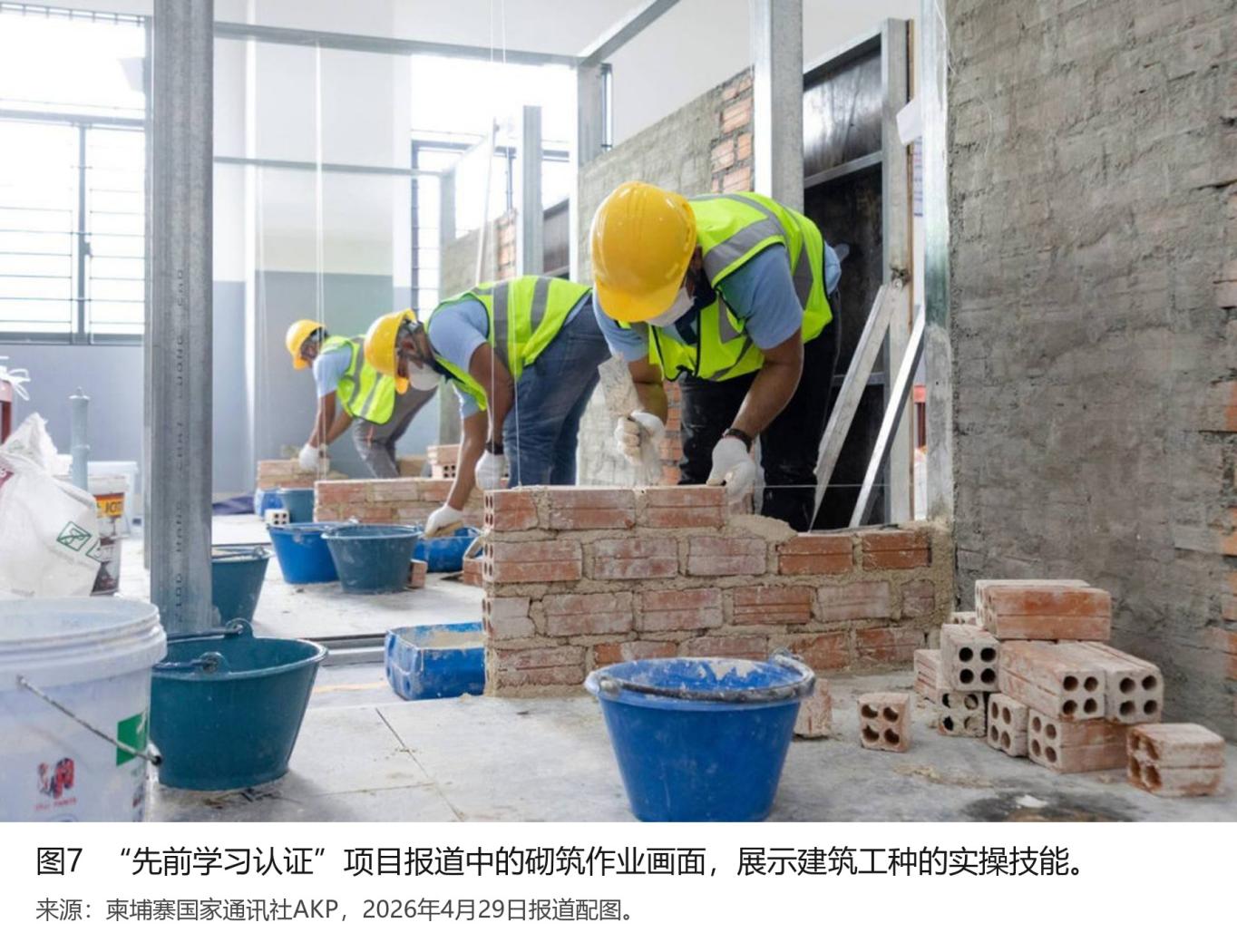
1. Turn skills into certificates. Recognition of Prior Learning is free and currently covers eight construction trades: masonry, tiling, formwork, plumbing, building electrical work, scaffolding, steel reinforcement and welding. So far, 10,000 people nationwide have received certificates. In Kakada's home province, the Battambang Institute of Technology has awarded certificates to nearly 100 workers who returned from Thailand.[19,20,21]
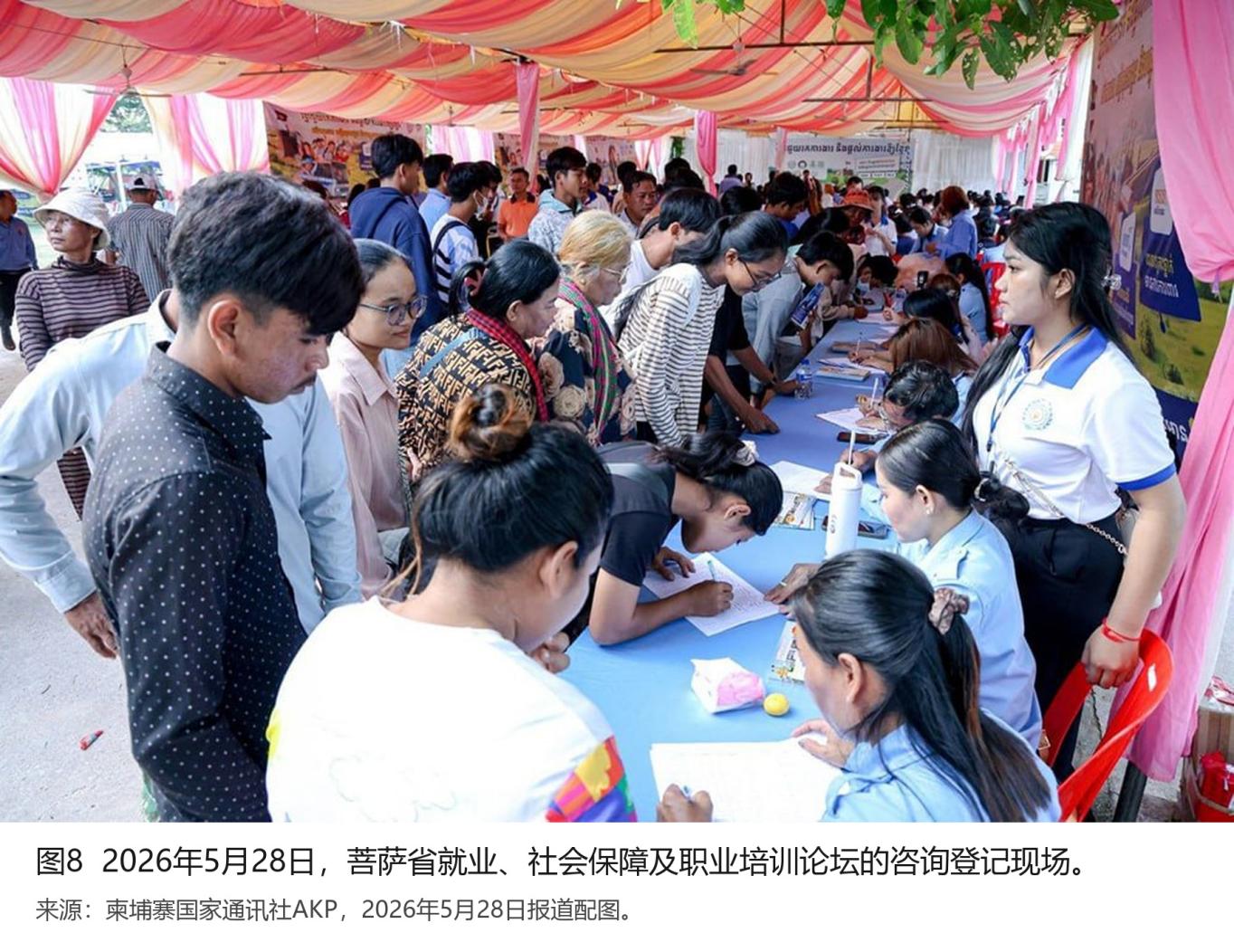
2. Learn a new skill. At the job forum in Pursat Province in May 2026, the Pursat Institute of Technology offered free enrollment in electrical work, auto repair, hotel services and other programs, with a monthly allowance during training. For returnees like Kakada, who did cleaning and other service work in Thailand, hotel services are a field close to their existing experience.[11,22]
3. Actively seek job matches. Register by calling the 1297 hotline and attend job fairs close to home. The Pursat forum alone offered more than 10,000 jobs.[12,22]
Options Are Widening
In the past, Cambodian workers seeking a living abroad went overwhelmingly to Thailand: even in 2025, Thailand still accounted for 77.3% of the country's remittances. The current wave of returns is pushing those options to become more diverse.[6]
At home, formal jobs have absorbed about 340,000 people, and agriculture and small businesses about 310,000.[5]
Abroad, legal channels for sending workers overseas are expanding. As of September 2026, 45,036 Cambodian workers were employed in South Korea, 22,545 in Japan and 5,421 in Malaysia. This year the Ministry of Labour and Vocational Training has also opened more than 31,000 overseas jobs in South Korea, Japan, Malaysia, Singapore and other destinations.[23]
The shift already shows in the remittance data. In 2025, remittances from Japan grew by 22.5%, the only increase among the top three source countries.[6]
Still, compared with nearly one million returnees, legal overseas jobs remain few. Most will have to find their footing at home.
Preah Sihanouk: One of the Key Destinations for Returning Workers
Among the places at home where returnees can settle, Preah Sihanouk Province has the industries, the policies, the will and the training, and it has the conditions to become an important one.
Industries. As of the end of 2024, the Sihanoukville Special Economic Zone hosted 202 companies providing about 32,000 jobs. From January to February 2026, exports by companies in the zone rose 20.5% year on year. For comparison, Cambodia's 33 operating special economic zones together employ more than 200,000 workers.[24,25,26]

Policies. The Special Investment Promotion Program for Preah Sihanouk Province, launched in 2024, had approved 467 projects worth more than US$8.18 billion as of March 2026. These projects are expected to create more than 55,000 jobs, and the program has been extended to the end of 2027. Industry and tourism are the province's two main priorities, and on September 14, 2026, the Preah Sihanouk Province Tourism Development Plan 2026–2030 was officially launched.[27,28,31]
Will. On June 27, 2025, while inspecting a wood processing plant project with an investment of about US$4.69 million, Preah Sihanouk Provincial Deputy Governor Long Dimanche asked the owner to give hiring priority to workers who had just returned from Thailand.[29*]
Training. On September 1, 2026, the Skills Development Fund, the Cambodia-Japan Cooperation Center and other institutions held skills cooperation dialogues in the Sihanoukville Special Economic Zone and the Zhejiang special economic zone to design training programs based on companies' actual hiring needs.[30]

There are limits, too. The more than 55,000 expected jobs were not created specifically for returnees. Compared with the roughly 770,000 returnees who remain in Cambodia, Preah Sihanouk can absorb only part of them, not all. To make that share as large as possible, the key is to solve the "geographic mismatch" described earlier: bring Preah Sihanouk's job listings to the border provinces, and link skills training directly to jobs in the special economic zones.[5,27]
For people like Kakada, who are tied down by family, Preah Sihanouk may not be a realistic option. But for returnees who can move, there is a link worth noting: research data show that about 19% of returnees worked in the service sector in Thailand, and the Preah Sihanouk tourism plan focuses on beach, island and marine tourism. With training and certification, experience gained in Thailand's service sector could lead to matching jobs in Preah Sihanouk.[3,31]

Conclusion: Where Is the Next Stop?
When interviewed in May this year, Kakada was still looking for a stable job and was supporting his mother and nephew with a small roasted-quail stall. His story has not ended yet. The question he faces is one shared by more than 800,000 returning workers: after coming home, where do they go next?[1]
Back in Ba Rang Village, the social problem behind the wave of returns is actually quite clear. Village chief Chea Han said, "It is very quiet here in Battambang." He was referring to the lack of industrial jobs in the area. With few jobs close to home and much higher incomes in Thailand, cross-border work became the main source of livelihood for countless families. A report jointly released in October 2025 by the Cambodia Development Resource Institute and the Economic Research Institute for ASEAN and East Asia shows that while working abroad, each of these workers sent home about US$400 a month, roughly half of household income. Once the border closed, this livelihood chain, sustained for many years, was broken.[1,32]
For the government, this means a forced transition. The employment pressure once eased by labour migration must now be absorbed by domestic industry, training and social protection. Yet it is also a considerable human resource. The same report shows that 96% of returnees are aged between 18 and 40, in the prime of their working lives. Whether they can be kept in formal jobs at home will decide whether the border provinces can develop. It will also decide whether the country can reduce its dependence on a single foreign market.[32]
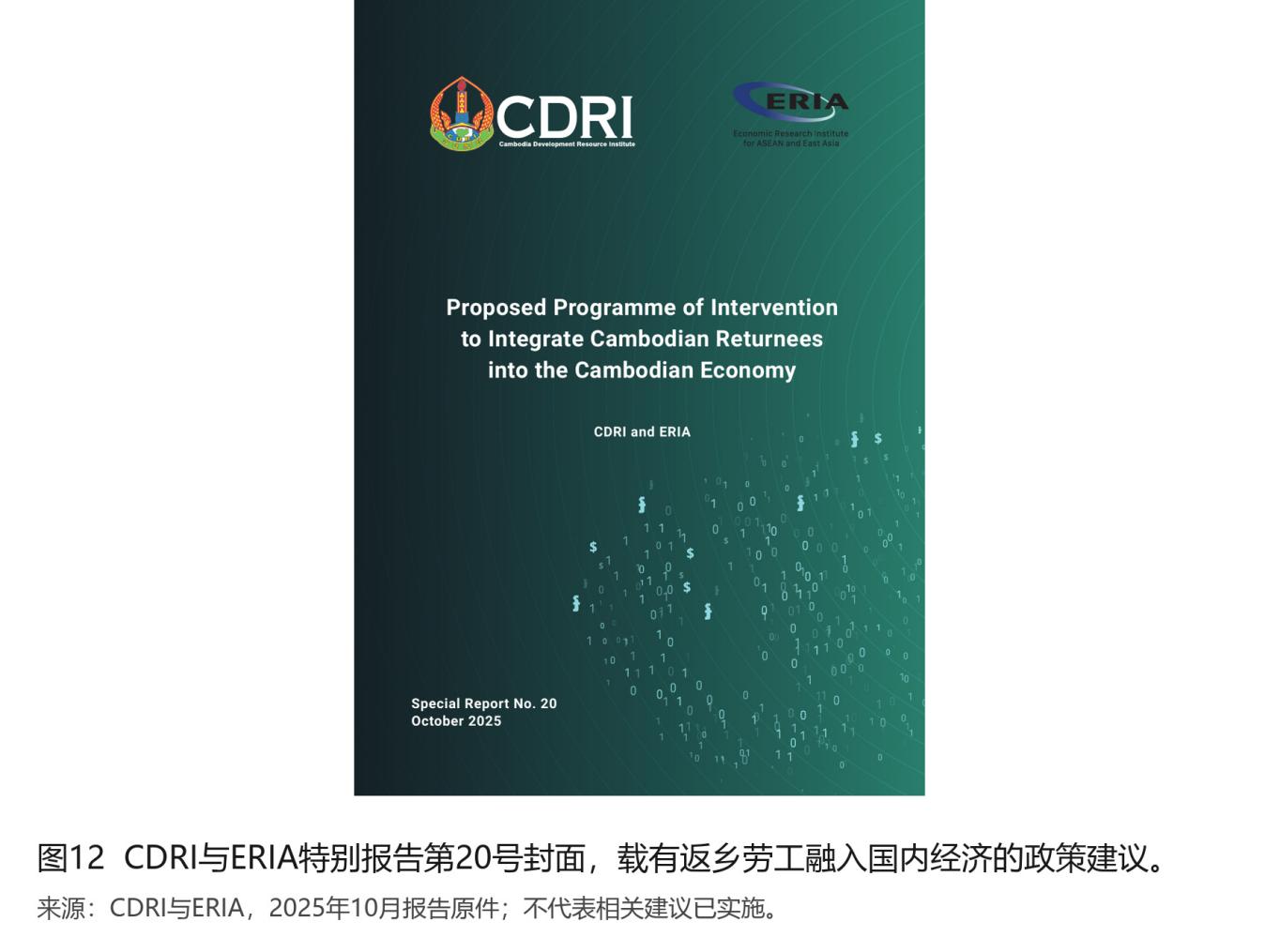
The state has already produced its first results: 340,000 people have entered formal jobs and 10,000 have received skills certificates. Measured against the returnee intervention plan proposed in the report, however, there is still a long way to go. The plan recommends certifying 50,000 people within one year, and only one-fifth of that has been achieved so far. Next, there are at least four areas where the state should focus its efforts:[5,19,32]
1. Extend certification to more sectors. Recognition of Prior Learning currently covers only eight construction trades. Yet while in Thailand, 29% of returnees worked in manufacturing, 19% in services and 16% in agriculture. Enabling factory workers, service staff and farm workers to obtain certificates is the most direct step.[3,20,32]
2. Bring jobs closer to home. More than 70% of returnees have gone back to border provinces, and a year's mobility costs are equivalent to seven months of income. The plan recommends building mango pre-cooling, packing and drying facilities in Banteay Meanchey and Battambang, creating 10,000 to 12,000 jobs by 2027. Building processing plants on returnees' doorsteps is a direct response to Kakada's words: "If I were on my own, I would go."[3,32]
3. Give small businesses access to formal finance. Returnees who turn to self-employment often have limited start-up capital. Kakada's capital came from the rent on a rice field. The plan recommends setting up a "Returnee Start-up Fund" that would provide grants of US$500 to US$1,500, along with loans guaranteed by the Credit Guarantee Corporation of Cambodia, to support 50,000 micro and small entrepreneurs within two years.[1,32]
1. Make businesses willing to hire returnees. The plan recommends giving businesses that hire returnees a subsidy worth 30% to 50% of wages for three to six months, and covering 50% of training costs for investors in special economic zones. For Sihanoukville, this is a bridge connecting jobs in the special economic zone with returnees in the border provinces.[32]
For returnees and their families, this means the old path is narrowing and the rules are changing. The figures cited earlier show that the old model is shrinking, in which people relied on acquaintances to lead the way and could find work simply by crossing the border. Formal jobs at home, and formal overseas employment channels to countries such as Japan and South Korea, value skills that can be proven. Those who are first to turn their experience into recognised skills are more likely to gain a foothold in their hometowns or in new overseas markets. Returnees can start with four things:
1. First, turn experience into a certificate. Certification is free, and certificates are issued by the Ministry of Labour. Estimates based on an International Labour Organization model show that skilled workers are more than four times as likely as unskilled workers to enter formal employment.[3,20]
2. Then use training to fill the gaps. National technical and vocational training is free for poor and vulnerable households, with a monthly allowance of 280,000 riels during the course.[11]
3. If going abroad, use formal channels. More than 31,000 overseas jobs opened this year cover destinations including South Korea, Japan and Malaysia. Remittances from Japan grew 22.5% last year, showing that this path works.[6,23]
4. Register in the system. Call the 1297 hotline or visit the nearest Migrant Worker Resource Centre so that jobs, training and protection can reach you.[12,14]
Nearly one million people have returned to their hometowns. Whether they can stay and live well will test the state's ability to turn policy into jobs on people's doorsteps. For every returning family, it is also a starting point for moving away from a single livelihood and planning the future anew.
Sources Cited in This Article
The bracketed numbers in the text correspond to the sources below. Amounts, employment figures and project targets are given as of each source's reference date. Model estimates, research recommendations and measures already implemented are each cited as stated in the original sources. Date of retrieval and verification: November 28, 2026.
[1] CamboJA/Seoung Nimol, republished by CENTRAL, June 12, 2026. Source link
Content cited: Kakada's work, income, family caregiving and stall, and the interview with village chief Chea Han. Photos taken on May 21, 2026.
[2] International Labour Organization, seminar page, November 18–19, 2026. Source link
Content cited: scale of returns (820,000 to 950,000), and the seminar dates and venue.
[3] International Labour Organization, Working Paper 179, September 30, 2026. Source link
Content cited: "When the Border Closes". Print pages 9 and 11: geographic distribution of returnees; 89% have no formally recognised skills; manufacturing 29%, services 19%, agriculture 16%. Page 32: calibration of mobility costs. Page 39, Table 10: skilled group 52%, unskilled group 12%. These two group rates are model results and should not be read as "obtaining a certificate directly brings a fourfold probability of employment."
[4] United Nations in Cambodia, "Life After Thailand: Stories from migrant women who returned to Cambodia due to the COVID-19 pandemic". Source link
Cited content: More than 265,000 people returned to Cambodia from Thailand during the COVID-19 pandemic.
[5] Agence Kampuchea Presse (AKP), April 23, 2026. Source link
Cited content: As of April 10, 2026, about 770,000 people had remained in the country, 340,000 had entered formal jobs, and 310,000 had entered agriculture and other informal economic activities.
[6] Agence Kampuchea Presse (AKP), March 30, 2026. Source link
Cited content: Remittances in 2025 totaled US$2.1 billion, with Thailand accounting for 77.3%; remittances from Thailand fell by 27%, while those from Japan rose by 22.5%; the report cited the National Bank of Cambodia.
[7] Khmer Times, republished by Vietstock, April 2026. Source link
Cited content: Nationwide remittances fell by 23.6% year on year. The decline for Thailand differs from the AKP figure; this article uses AKP's 27% for Thailand.
[8] Khmer Times, republished by Vietstock, January 2026. Source link
Cited content: Citing the World Bank's assessment that the poverty rate could rise by about 1 percentage point in the short term.
[9] Agence Kampuchea Presse (AKP), June 16, 2025. Source link
Cited content: Border employment services, mobile employment centers, and registration for free vocational training.
[10] Press and Quick Reaction Unit, Office of the Council of Ministers of Cambodia, June 14, 2025. Source link
Cited content: Republished from AKP: Hun Manet called on the banking association and the microfinance association to ease the debt burden on returnees.
[11] The Cambodia Daily, August 6, 2025. Source link
Cited content: Cash assistance for poor/vulnerable households, free vocational training, and a monthly allowance of 280,000 riel.
[12] The Phnom Penh Post, August 13, 2025. Source link
Cited content: "Protecting returning workers: Starting next week, up to 100 job forums per day"; more than 110,000 jobs from August 2–11, 16,824 people hired on the spot, and more than 60,000 people employed nationwide during the same period.
[13] Agence Kampuchea Presse (AKP), March 27, 2026. Source link
Cited content: Interview with Chok Kunthea, who works at T.S. Sport; the 1297 hotline; more than 600 job forums; and more than 1,000 mobile job fairs.
[14] International Labour Organization, February 18, 2026. Source link
Cited content: A 24-month Japan-supported employment project for returning workers, expected to benefit 20,000 people, with plans to set up resource centers in three provinces.
[15] Embassy of Japan in Cambodia, Press Release No.10 PR-26/EoJ, February 18, 2026. Source link
Cited content: the US$1 million grant and the project areas.
[16] The Phnom Penh Post/Asia News Network, August 6, 2025. Source link
Cited content: Heng Sour's remarks on domestic wages, NSSF healthcare and retirement coverage, prenatal checkups and maternity allowances.
[17] Xinhua/The Star, September 17, 2025. Source link
Cited content: the 2026 monthly minimum wage of US$210 for the garment, footwear and travel goods industries, taking effect on January 1, 2026.
[18] Xinhua/The Star, September 30, 2026. Source link
Cited content: the 2027 monthly minimum wage of US$212, taking effect on January 1, 2027, or US$231.5–242.5 once regular allowances are included.
[19] International Labour Organization, August 11, 2026. Source link
Cited content: the Battambang employment forum's 400 participants and 1,000 jobs, the interview with Kan Chek, and the 10,000 people already granted skills certification.
[20] Agence Kampuchea Presse (AKP), April 29, 2026. Source link
Cited content: Recognition of Prior Learning certification is free, and its first phase covers eight construction trades.
[21] The Phnom Penh Post, May 19, 2026. Source link
Cited content: "Certification programme for returning migrant workers showing promise": nearly 100 returning migrant workers certified at the Battambang Institute of Technology.
[22] Agence Kampuchea Presse (AKP), May 28, 2026. Source link
Cited content: the more than 10,000 jobs at the Pursat employment forum, and the Pursat Institute of Technology's free vocational training and monthly allowances.
[23] Le Petit Journal Cambodge, October 3, 2026. Source link
Cited content: according to the Cambodian Ministry of Information on September 25, there were 45,036 workers in South Korea, 22,545 in Japan and 5,421 in Malaysia, plus more than 31,000 jobs available overseas.
[24] Xinhua/People's Daily Online (English edition), January 8, 2025. Source link
Cited content: the Sihanoukville Special Economic Zone had 202 companies and about 32,000 jobs as of the end of 2024. The factory photo was taken on May 22, 2023, by Ly Lay.
[25] Khmer Times, republished by Vietstock, March 2026. Source link
Cited content: the Sihanoukville Special Economic Zone's exports rose 20.5% year-on-year in January–February 2026.
[26] Cambodia Investment Review, June 12, 2026. Original link
Cited content: Report on the EuroCham forum: 33 operating special economic zones, 642 factories and more than 200,000 workers. The figures are as of the time of the report.
[27] Construction & Property, April 3, 2026. Original link
Cited content: Report on the March 25, 2026 meeting: a cumulative 467 projects, US$8.18 billion and about 55,124 jobs. The number of jobs in the article is understood as the expected scale of the projects, not as the number of returnees already employed.
[28] Agence Kampuchea Presse (AKP), January 13, 2026. Original link
Cited content: The special investment promotion program for Preah Sihanouk Province has been extended to the end of 2027.
[29*] Source lead listed in the original manuscript: Construction & Property, wood processing factory recruiting returning workers. Original link
Cited content: Pending verification: the original article at the listed link could not be obtained this time, so the date of June 27, 2025, the figure of US$4.69 million and the priority recruitment requirement cannot yet be independently confirmed. The main text retains the wording of the original manuscript and flags it with [29*].
[30] Skills Development Fund (SDF) Cambodia, report on a September 2026 event. Original link
Cited content: On September 1, SDF, CJCC and EDI held a skills cooperation dialogue at the Zhejiang special economic zone and the Sihanoukville Special Economic Zone.
[31] Asia Gaming Brief, September 16, 2026. Original link
Cited content: Citing AKP: the Preah Sihanouk Province Tourism Development Plan 2026–2030 was launched on September 14, with a focus on beach, island and marine tourism.
[32] CDRI and ERIA, Special Report No.20, October 2025. Original link
Cited content: "Proposed Programme of Intervention to Integrate Cambodian Returnees into the Cambodian Economy." Printed page 1: 96% are aged 18–40, send home about US$400 a month, which is about half of household income; page 8: wage subsidies of 30%–50% for 3–6 months; page 10: a target of 10,000–12,000 jobs in mango processing; page 11: start-up grants of US$500–1,500, supporting 50,000 people over two years; page 13: a 50% subsidy for training costs in special economic zones; page 16: certification of 50,000 people within 12 months. These targets and subsidy arrangements are recommendations of a research proposal, not policies already in place or official commitments. The "one fifth" figure is a comparison of numbers in the article, not an official rate of target completion.
[33] TNAOT Media, April 29, 2026; photo credit: Sihanoukville Autonomous Port (PAS). Original link
Cited content: Report and on-site photos of the cruise ship Viking Orion calling at Sihanoukville Port.
Index of Photo Sources
Photo 1: On May 21, 2026, Run Kakada and his mother sit beneath a palm-leaf house in Ba Rang Village, Battambang Province. Source [1]
Photo 2: On July 27, 2025, Cambodian workers returning home from Thailand carry their luggage through a border checkpoint. Source [1]
Photo 3: At a border employment service site, staff give returnees information on finding jobs and on vocational training. Source [9]
Figure 4: Representatives of Japan, Cambodia and the International Labour Organization pose for a group photo at a project signing event in Phnom Penh on February 18, 2026. Source [14]
Figure 5: Production at a factory in Kampong Speu Province. At the same time, Agence Kampuchea Presse interviewed workers who had returned from Thailand and found jobs locally. Source [13]
Figure 6: Kan Chek, a returning female worker, at an employment forum in Battambang Province on August 11, 2026. Source [19]
Figure 7: Masonry work shown in a report on the "Recognition of Prior Learning" program, showing hands-on skills in construction trades. Source [20]
Figure 8: Consultation and registration at the Employment, Social Security and Vocational Training Forum in Pursat Province on May 28, 2026. Source [22]
Figure 9: Inside the General Tire factory in the Sihanoukville Special Economic Zone, photographed on May 22, 2023. Source [24]
Figure 10: A skills cooperation dialogue in the Sihanoukville Special Economic Zone on September 1, 2026, aimed at matching training with business needs. Source [30]
Figure 11: The cruise ship Viking Orion docked at the port of Sihanoukville on April 29, 2026. Source [33]
Figure 12: Cover of CDRI and ERIA Special Report No. 20, which contains policy recommendations on bringing returning migrant workers into the domestic economy. Source [32]
Figure 13: Returning workers register for job and vocational training opportunities at an employment forum in Battambang Province on August 11, 2026. Source [19]