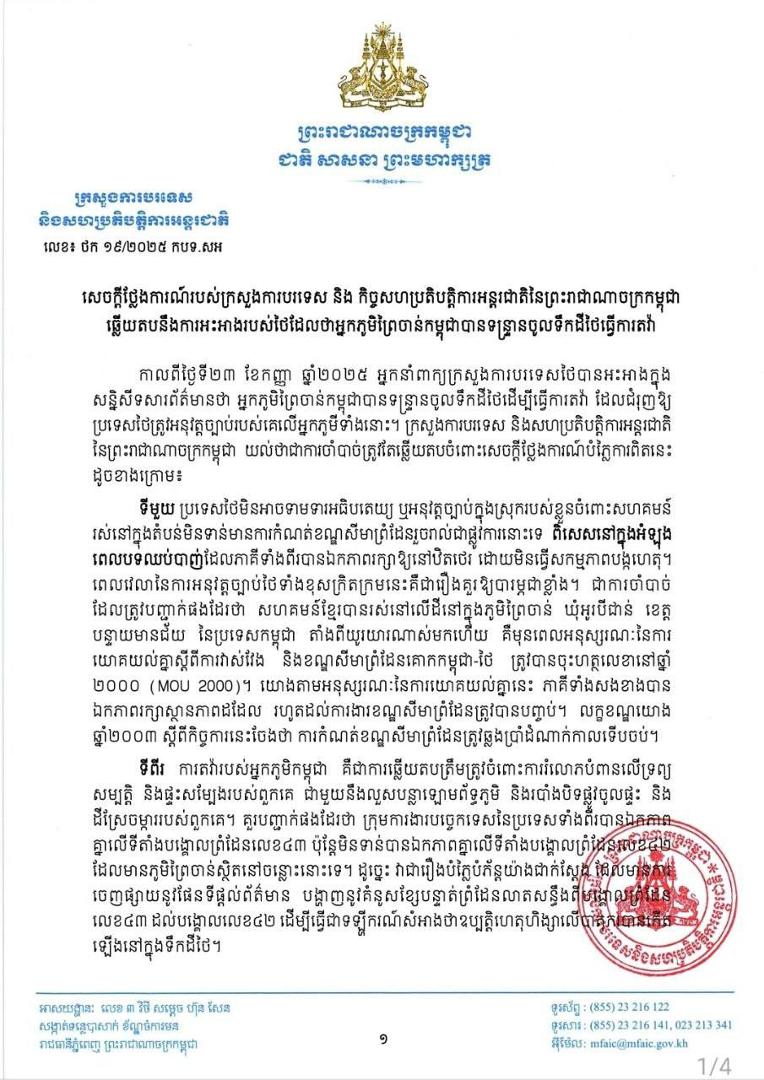
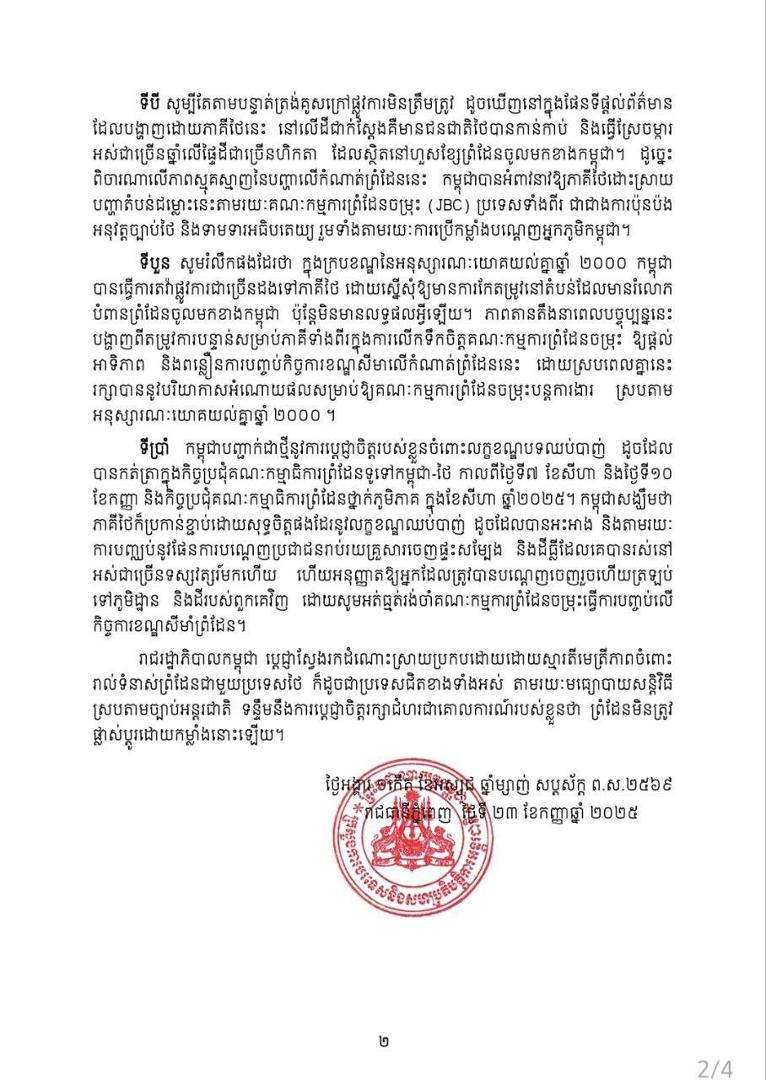
Cambodia’s Ministry of Foreign Affairs issued a statement responding to Thailand’s claim that Cambodian villagers from ព្រៃចាន់ had encroached on Thai territory to protest. The ministry said their protest was a legitimate response to violations of their property and homes, including barbed wire surrounding the village and barriers blocking access to homes and farmland. It said Thailand could not claim sovereignty or enforce its domestic law over communities in an area where boundary demarcation remained incomplete.
According to the Ministry of Foreign Affairs and International Cooperation’s letter, Thailand cannot claim sovereignty or apply its domestic law to communities in an area not yet formally demarcated, particularly during a ceasefire in which both sides agreed to maintain the status quo and avoid provocative actions. The ministry expressed deep concern about the timing of what it described as Thailand’s improper law enforcement. It stressed that Cambodian communities had long lived in ព្រៃចាន់ village, អូរបីជាន់ commune, Banteay Meanchey province, before the Memorandum of Understanding on the Survey and Demarcation of the Cambodia–Thailand Land Boundary was signed in 2000. Under that MOU, both sides agreed to maintain the status quo until demarcation was complete. The 2003 Terms of Reference set out five stages for completing the work.
The ministry further said the villagers’ protests were a legitimate response to violations of their property and homes, including barbed wire around the village and barriers to their houses and farmland. It noted that the two countries’ technical teams had agreed on the position of boundary pillar No. 43 but had not agreed on pillar No. 42, with ព្រៃចាន់ village lying between them. It therefore described as clearly misleading the publication of a schematic map drawing a boundary line between pillars 43 and 42 to support a claim that violence against protesters occurred on Thai territory.
“Even according to the unofficial and incorrect straight line on the schematic map shown by the Thai side, Thai nationals have in fact occupied and farmed many hectares of land for years beyond that line on the Cambodian side. Given the complexity of this boundary section, Cambodia has called on Thailand to resolve the disputed area through the two countries’ Joint Boundary Commission (JBC), rather than attempting to enforce Thai law and claim sovereignty, including by forcibly expelling Cambodian villagers,” the ministry added.
The ministry recalled that, within the framework of the 2000 MOU, Cambodia had repeatedly lodged formal protests asking Thailand to rectify encroachments into the Cambodian side, without results. It said the current tension highlighted an urgent need for both sides to encourage the JBC to prioritise and accelerate completion of demarcation on this boundary section while preserving a favourable environment for its work under the MOU.
Cambodia reaffirmed its commitment to the ceasefire terms recorded at the Cambodia–Thailand General Border Committee meetings on August 7 and September 10 and the Regional Border Committee meetings in August 2025. It expressed hope that Thailand would also honour those terms in good faith, halt plans to expel hundreds of families from homes and land occupied for decades, and allow people already expelled to return while patiently awaiting completion of demarcation by the JBC.
The Cambodian government pledged to seek friendly, peaceful solutions to all boundary disputes with Thailand and other neighbours in accordance with international law, while maintaining its principled position that borders must not be changed by force.
Preah Sihanouk Provincial Television; by: ង៉ែត ពិសាន្ត