When people think of Cambodia, Angkor Wat is often the first thing that comes to mind. But if one happens to catch a classical dance performance some evening in Phnom Penh or Siem Reap, one may discover that the most moving thing about this country is hidden in the backward-arched fingertips of its dancers.
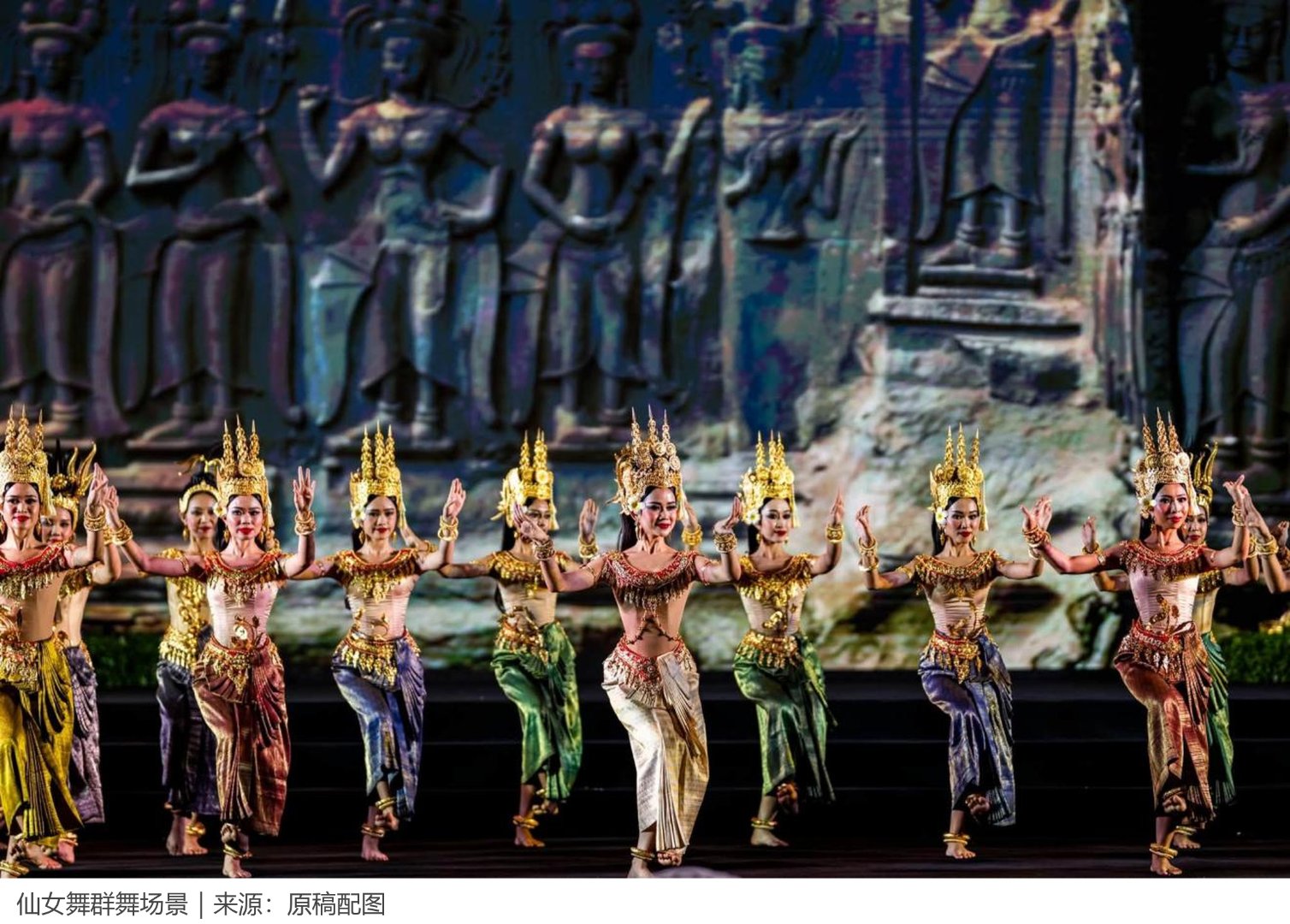
This dance is called Khmer classical dance (Robam Preah Reach Trop, meaning "Dance of Royal Wealth"). It holds immense weight in the hearts of Cambodians, and was once performed only inside the royal palace.
The meticulous care behind this dance can be seen in the costume itself: it is not put on — it is sewn on.
From the Stone Walls of Angkor to the Palace Stage
In the galleries of Angkor Wat, hundreds upon hundreds of celestial maiden reliefs can be seen: pointed crowns on their heads, one foot slightly lifted, palms turned outward. They are called Apsara, celestial nymphs who dance for the gods in Hindu mythology. The Apsara Dance performed on stage today takes its form from these very reliefs. The reliefs can only capture a single moment of these celestial maidens; the dancers link these moments together one by one, and the maidens on the stone walls begin to move.
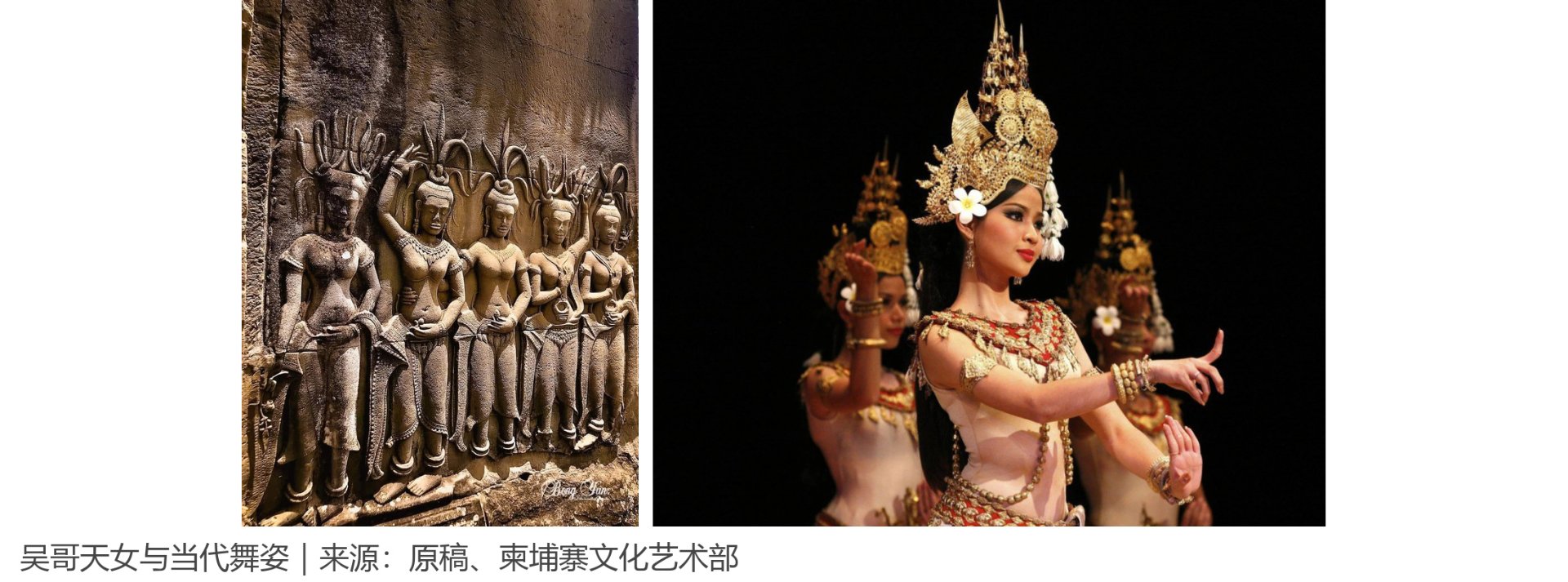
That said, today's classical dance has not been transferred unchanged from the stone walls. In the mid-twentieth century, Queen Kossamak personally led the Royal Ballet, redesigning the costumes and replacing the originally Thai-language sung lyrics with Khmer.
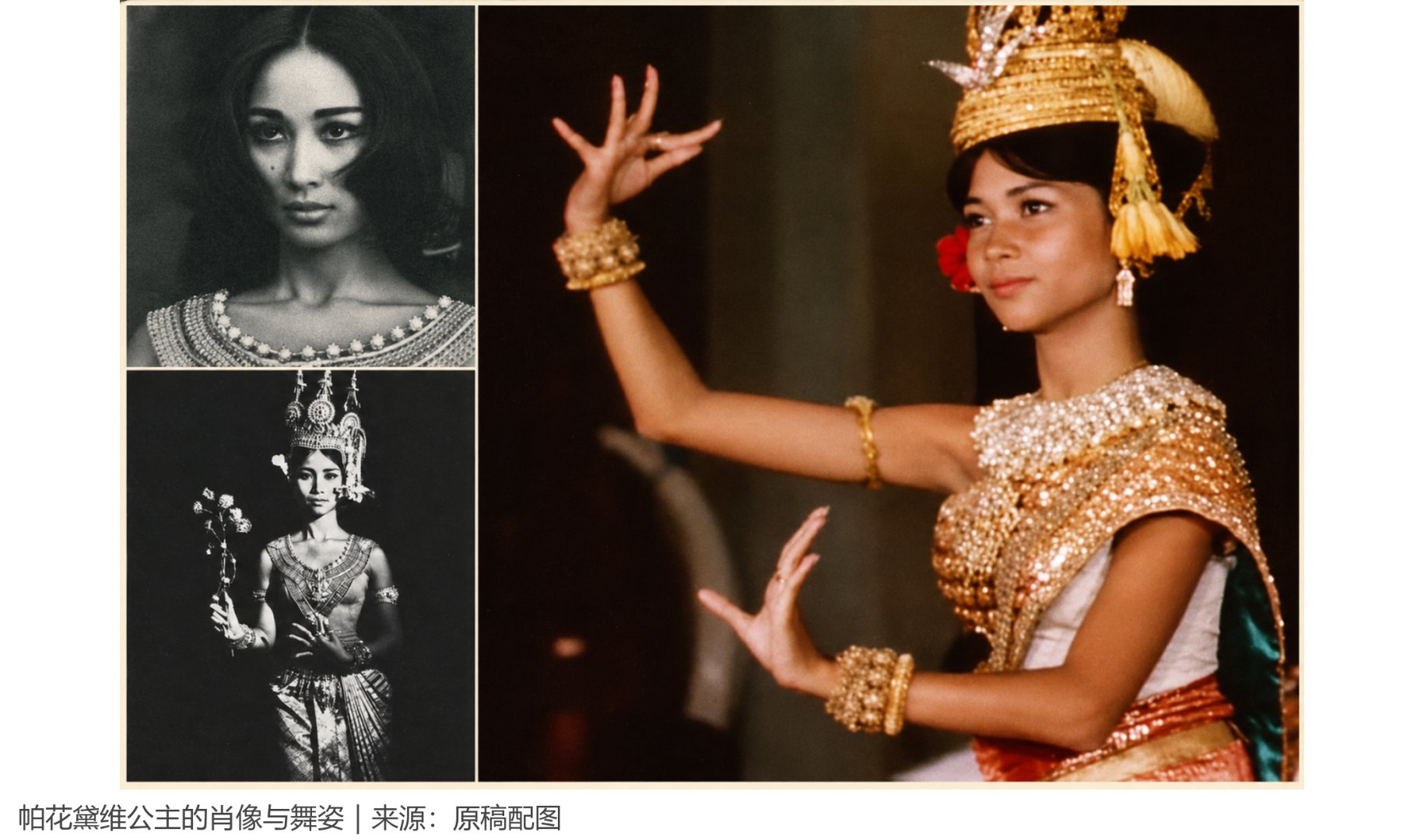
When the Queen reworked the Apsara Dance, the first to bring it to the stage was her granddaughter, Princess Norodom Buppha Devi (1943–2019). The Princess grew up in the royal ballet troupe, learning gesture by gesture from her grandmother. The fate of this dance later became bound up with her own.
A Dance Performed for the Gods
To put it simply, this is a dance that tells stories with the body. The dancers themselves do not speak; the story is told through gestures, postures, and the singing at the side of the stage.
In Cambodia, it was originally never meant as mere entertainment. In the past it was performed only at the king's important ceremonies, and people believed that the dance could carry earthly prayers up to the heavens.
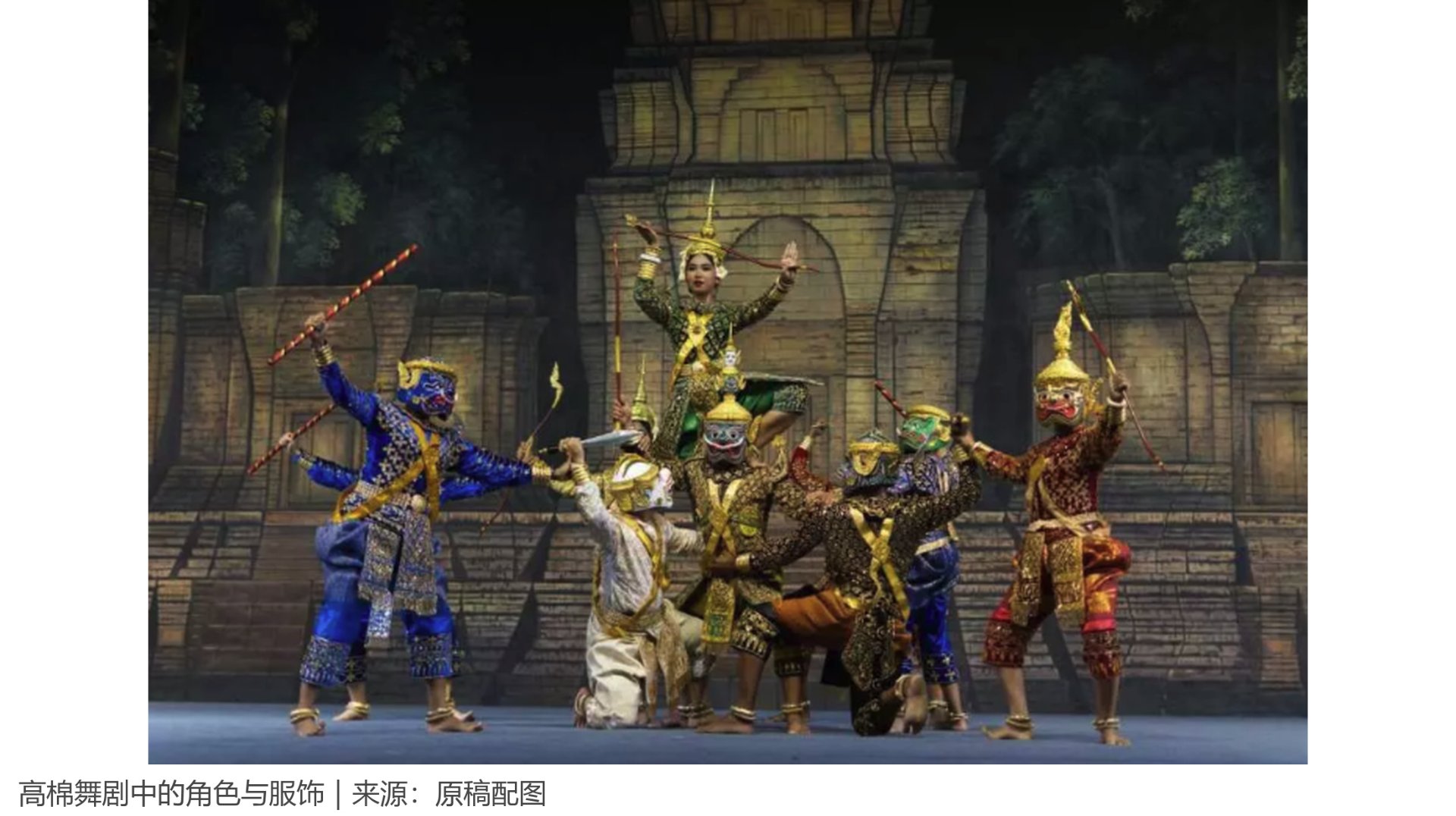
There are four types of characters on stage:
• Female role (Neang): the most gentle and reserved in movement.
• Male role (Neayrong): stands wider, with broader gestures.
• Ogre (Yeak): masked, stepping with high-raised knees, fierce in bearing.
• Monkey (Sva): also masked, leaping up and down, often drawing laughs from the audience.
In the past, the palace dancers were almost all women, with princes, ogres and monkeys all played by girls. Nowadays male dancers appear on stage as well, especially in the monkey and ogre roles.

A Pair of Hands, a Costume, and an Orchestra
What sustains a Khmer classical dance performance comes down to three things: the dancer's hands, the costume sewn onto the body, and the orchestra that speaks on the dancer's behalf.
A Pair of Hands That Speak
On first watching Khmer classical dance, many find it slow. A foot rises, then stops; a wrist turns, then stops again. But after watching for a while, one realises that the beauty lies precisely in these pauses: each movement is fully completed before the next one begins.
This slowness is a small test for today's audiences. In this fragmented information age, images on our phones switch every few seconds, and people's patience for watching anything is growing ever shorter. Sitting in the audience and waiting for a pose to settle, one may at first find it hard to stay still; but once the mind calms and follows along, the slowness becomes a form of ease.
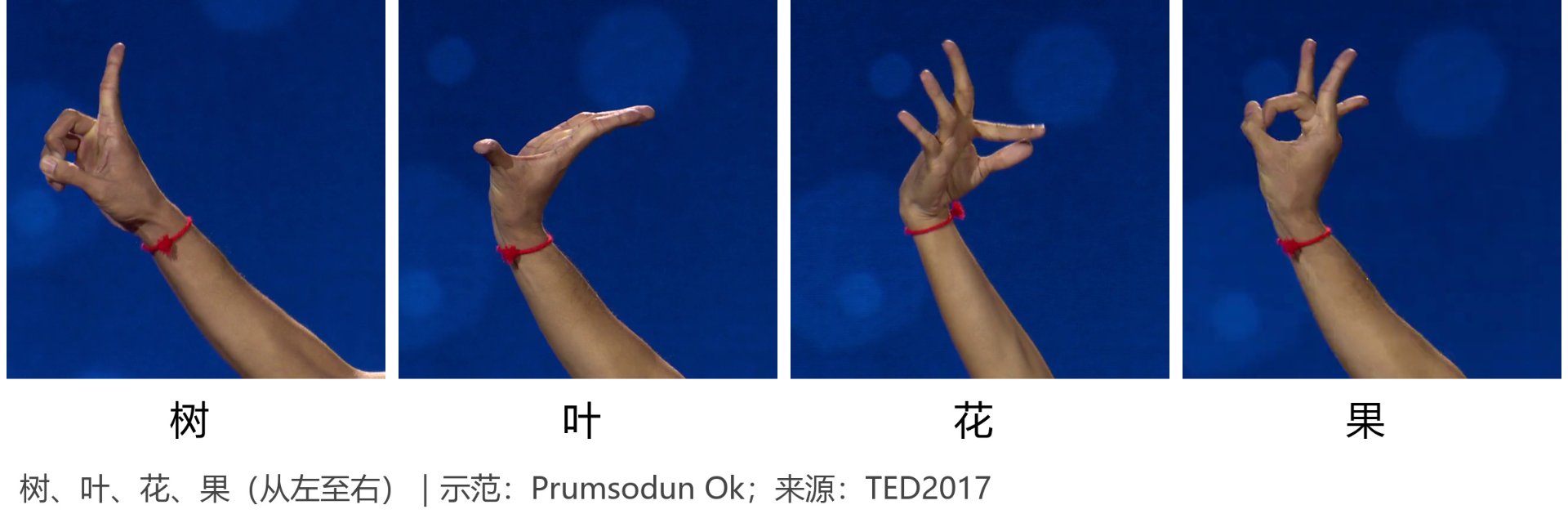
The story on stage is told entirely through movement. These gestures are somewhat like sign language, called "kbach" in Khmer. Beginners first learn the four most basic ones: tree, leaf, flower, fruit. When the fruit ripens and falls, a new tree grows — exactly a cycle of life. The same gesture held before the chest or raised above the head carries a different meaning.
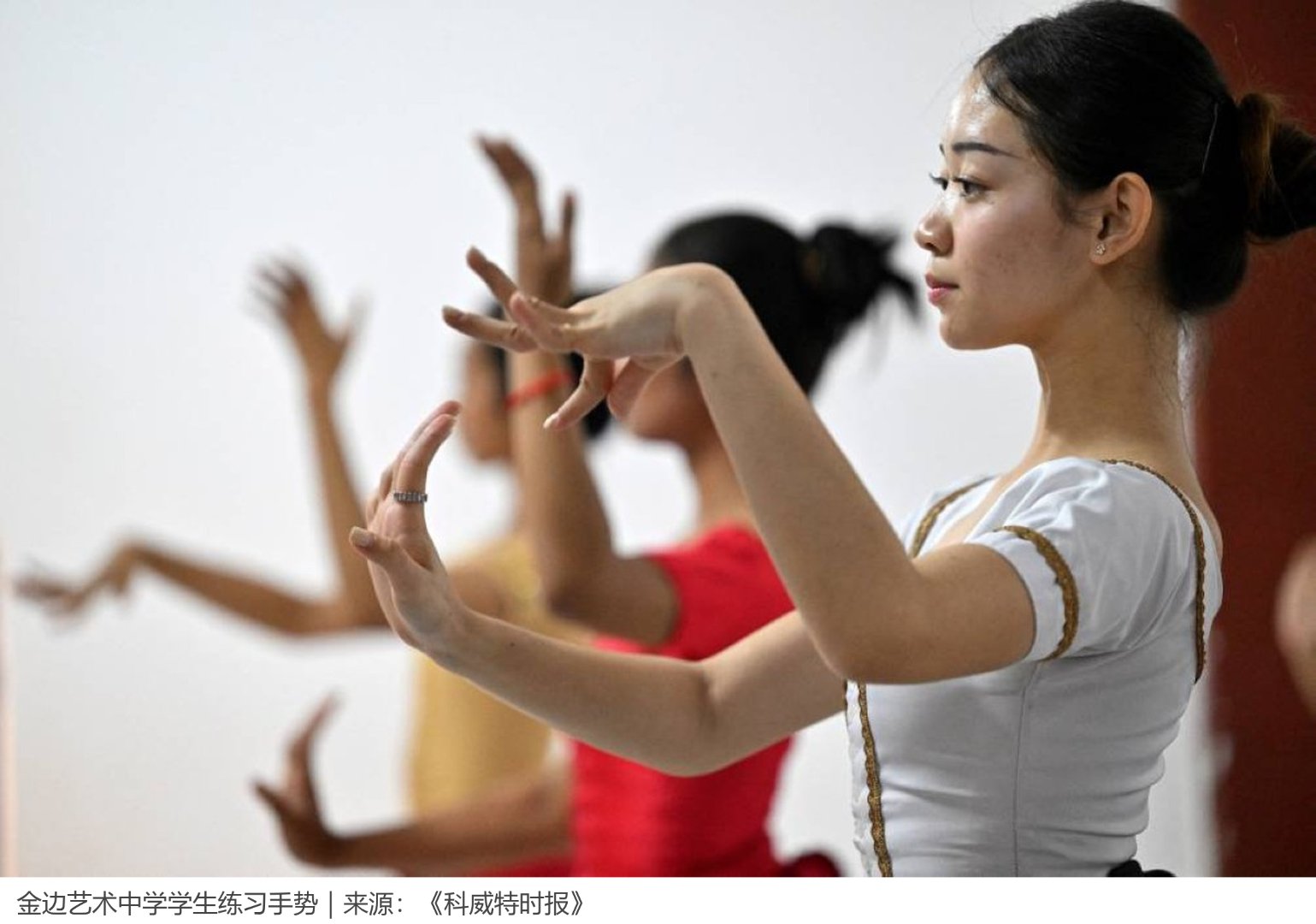
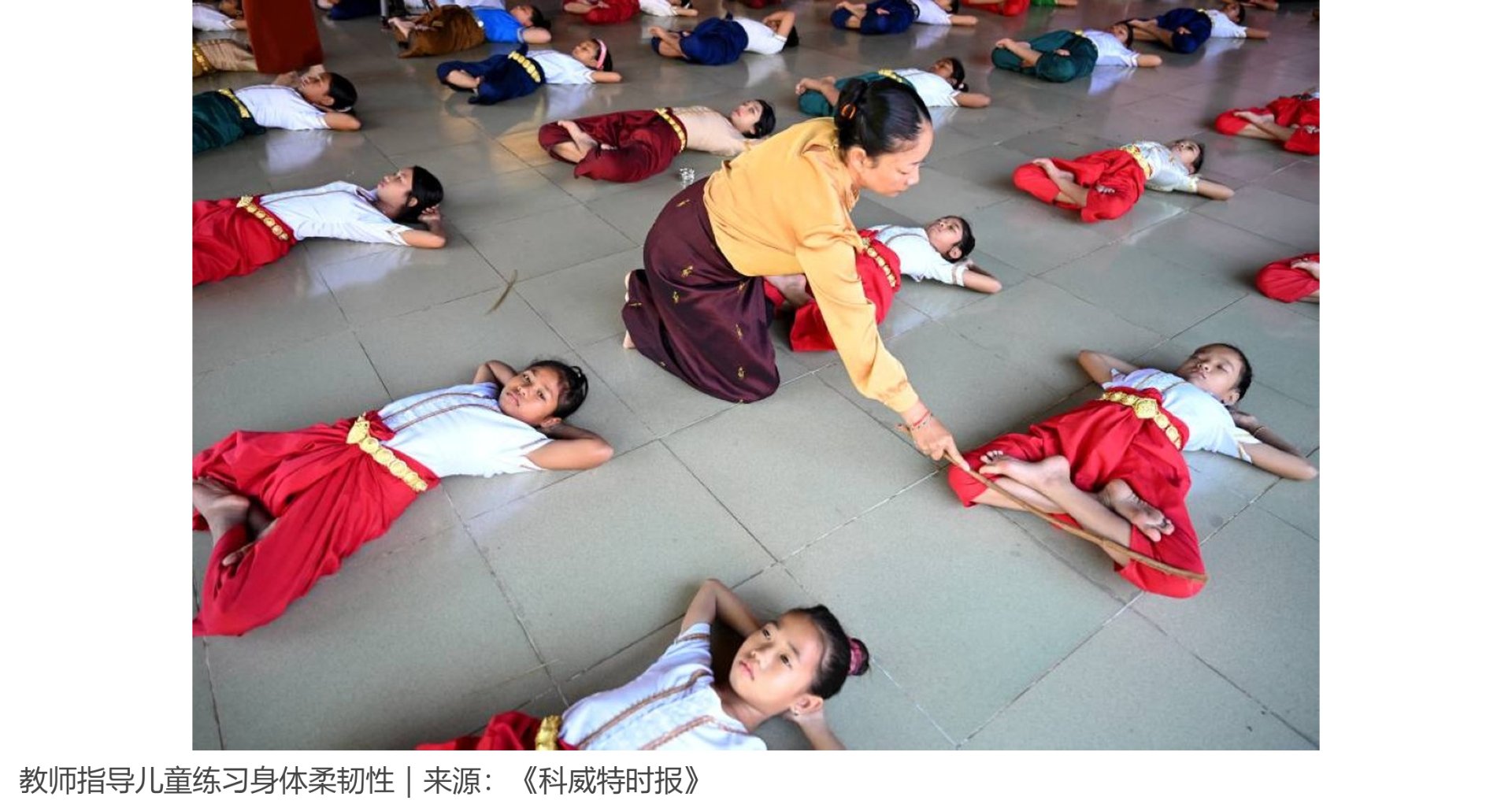
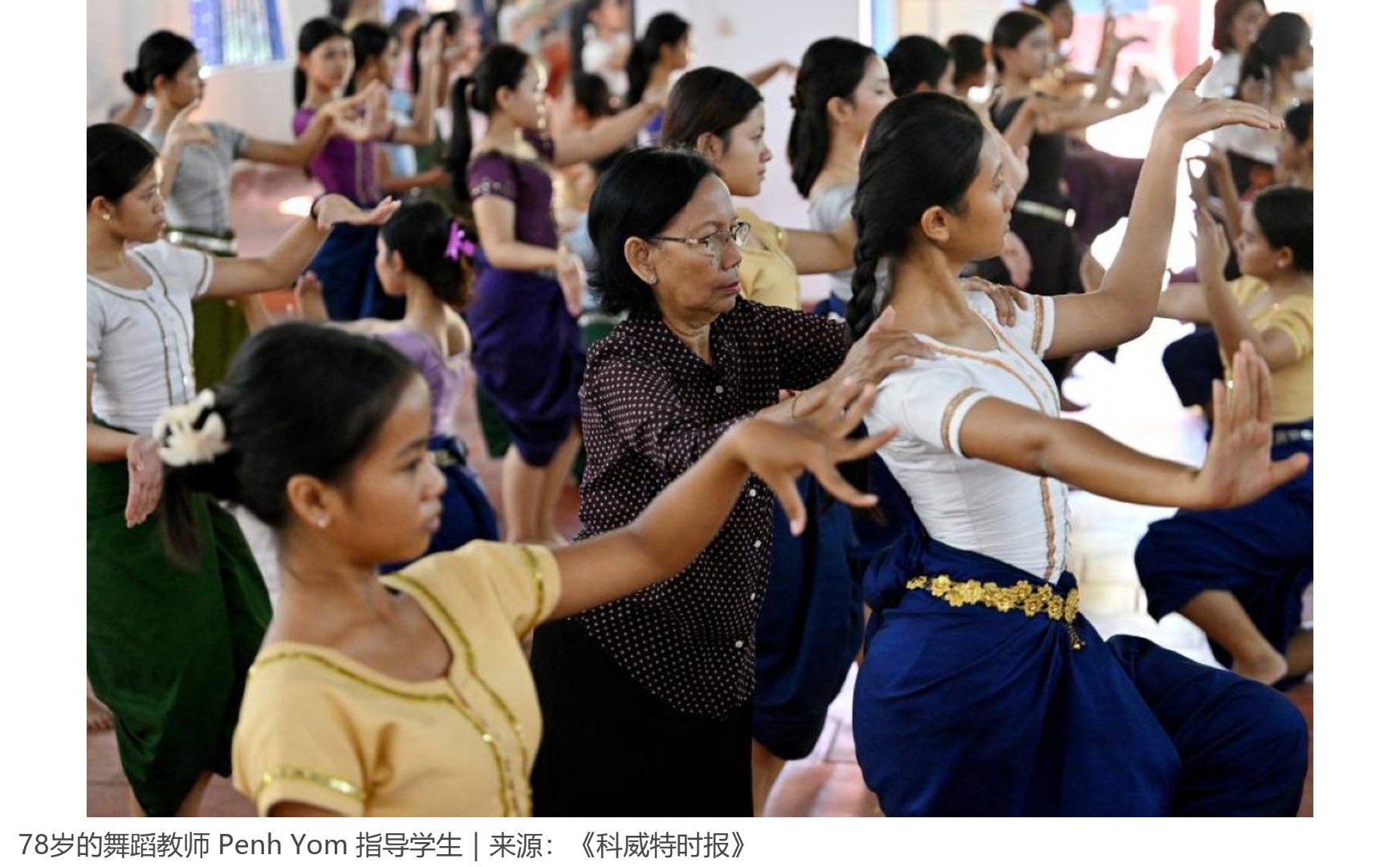
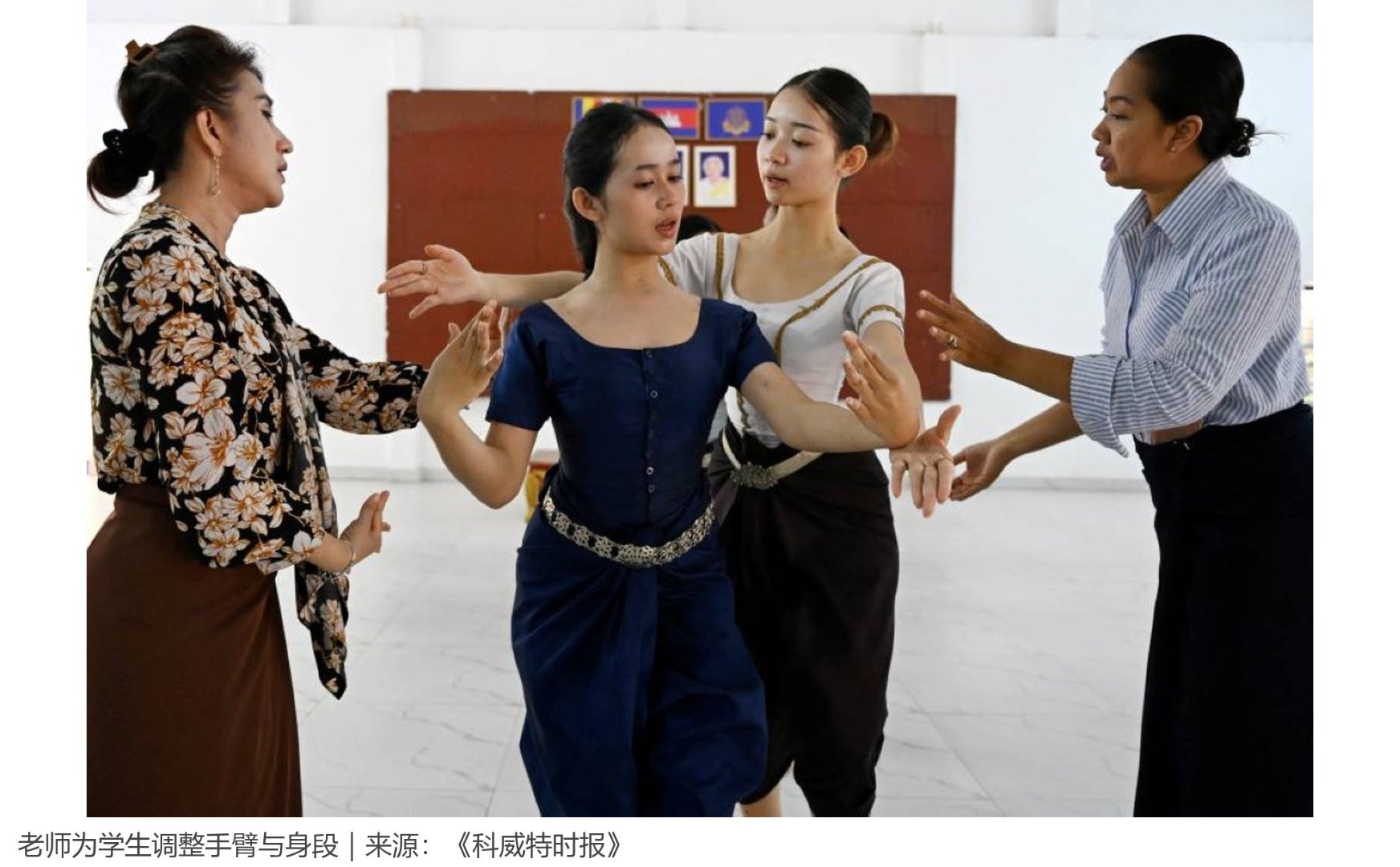
Most unforgettable are the dancers' fingers, bent backwards until they almost touch the wrist — the result of training from childhood. In former times, palace dancers moved into the royal palace at around eight years old and trained daily under the watchful eye of their teachers. The work of the feet is no easier either: standing on one leg, knees slightly bent, holding a single pose steady for several beats.
The dancers' faces show almost no exaggerated expression, remaining calm throughout, with a hint of a smile at the corners of the mouth. Joy, anger, sorrow and delight are all entrusted to the hands.
A Costume Sewn onto the Body
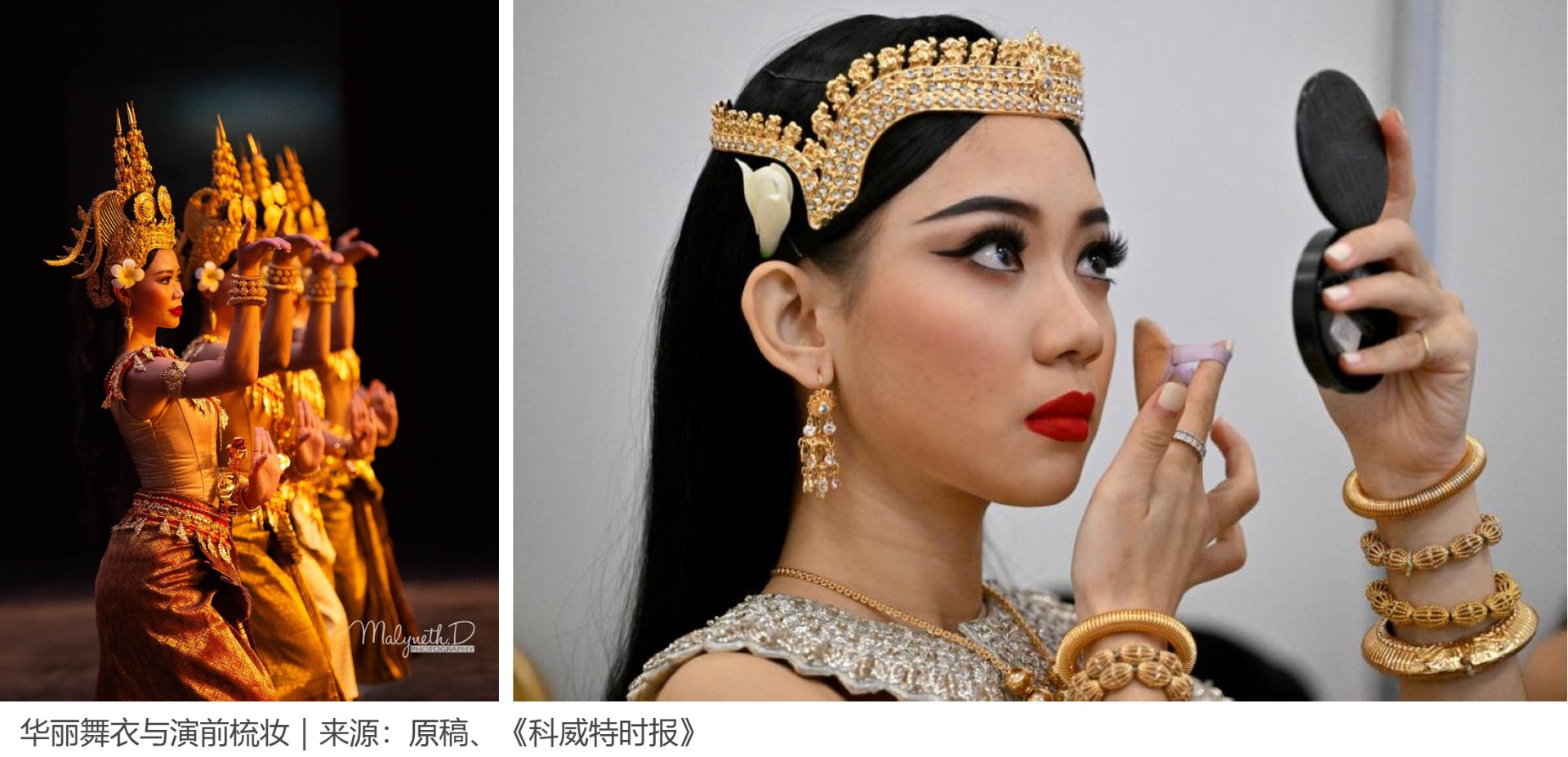
The costume is extraordinarily ornate: a golden pointed crown (mokot), gleaming brocade, bracelets, arm rings, and shoulder ornaments. When a dancer takes to the stage, she looks as though a deity has stepped down from a temple.
As mentioned at the start, the costume is sewn on. Before every performance, someone must take a needle and thread and sew the costume tightly onto the dancer's body, a process that can take two or three hours. Zippers are not used, because only sewing can make it fit close enough. Once the garment is sewn in place, it cannot be taken off until the dance is over — even going to the toilet is inconvenient — so in the old palace days, dancers would eat and drink as little as possible on performance days.
The close fit is not merely for appearance. Only when the costume and body become one can the body's lines remain complete as the dancer bends her back to the extreme and twists her elbows outward. Sewing the costume onto the dancer is the work of specialised dressers — a craft in its own right.
An Orchestra That Speaks for the Dancers
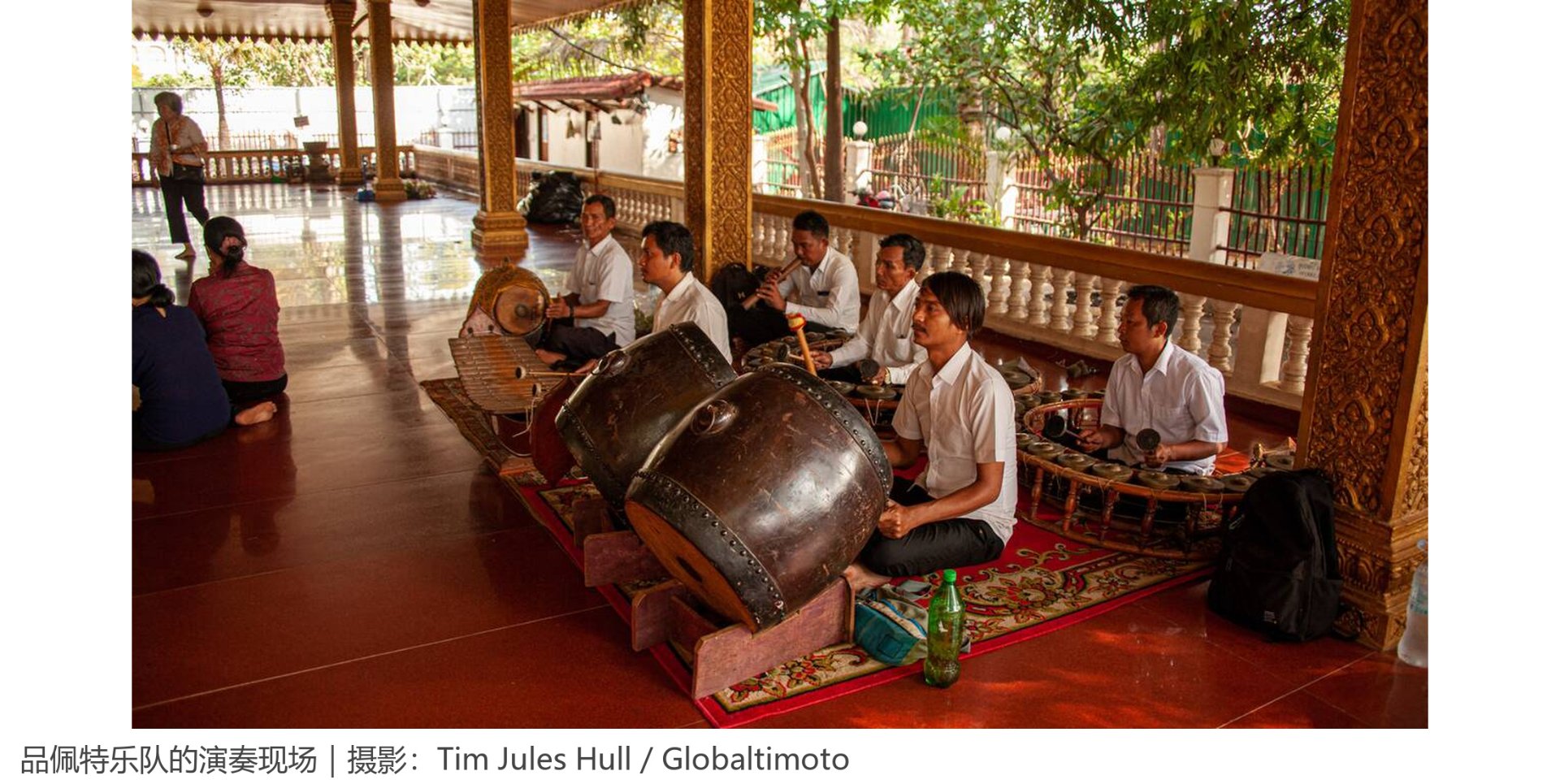
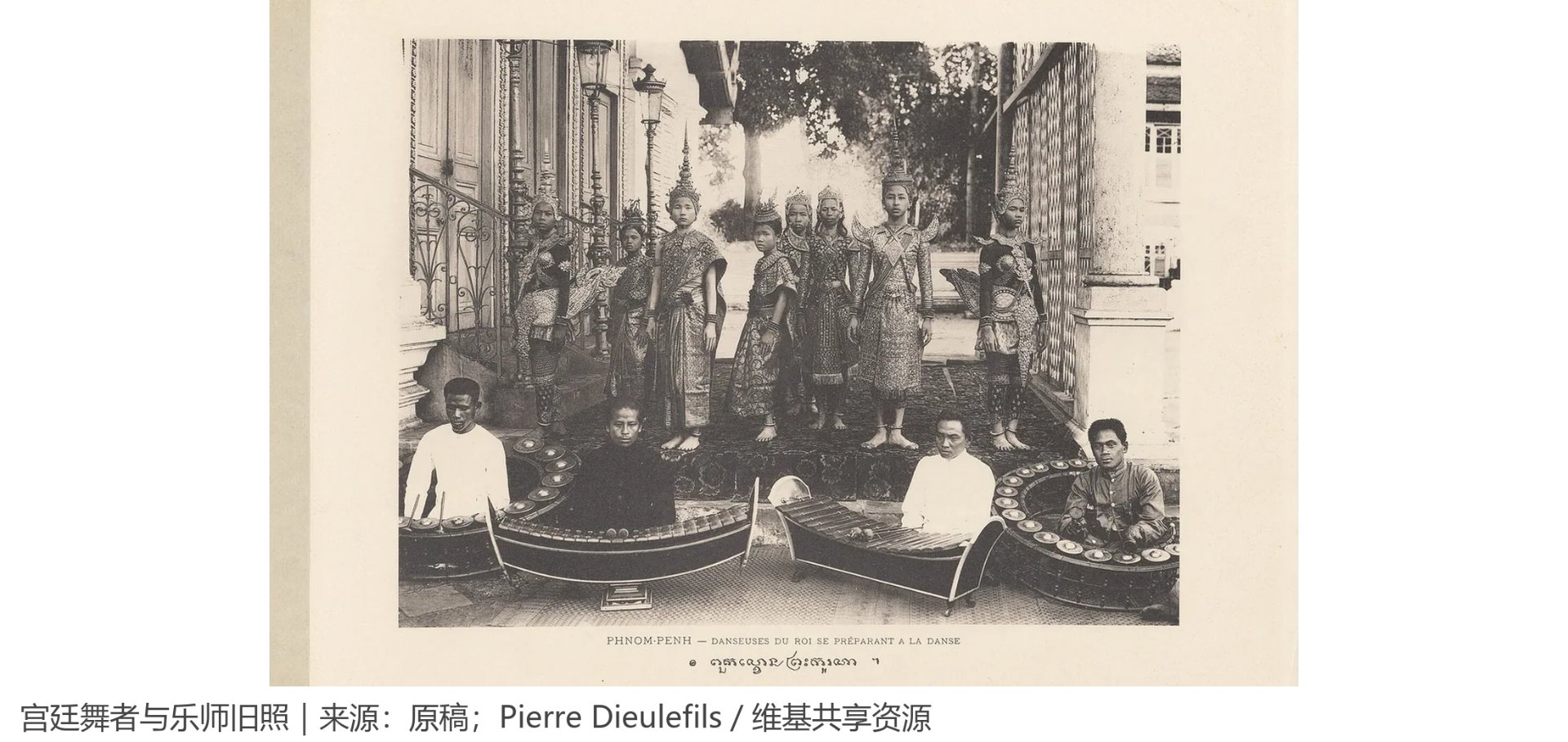
The dancers do not speak; the storytellers are at the side of the stage. The singers voice the characters' inner thoughts and recount where the story has gone, while the musicians set the rhythm of the whole performance.
The orchestra plays rapidly and densely, with hardly any pause, while the dancers on stage are unhurried, each pose held steady for several beats before moving on to the next. One fast, one slow — yet the two mesh seamlessly.
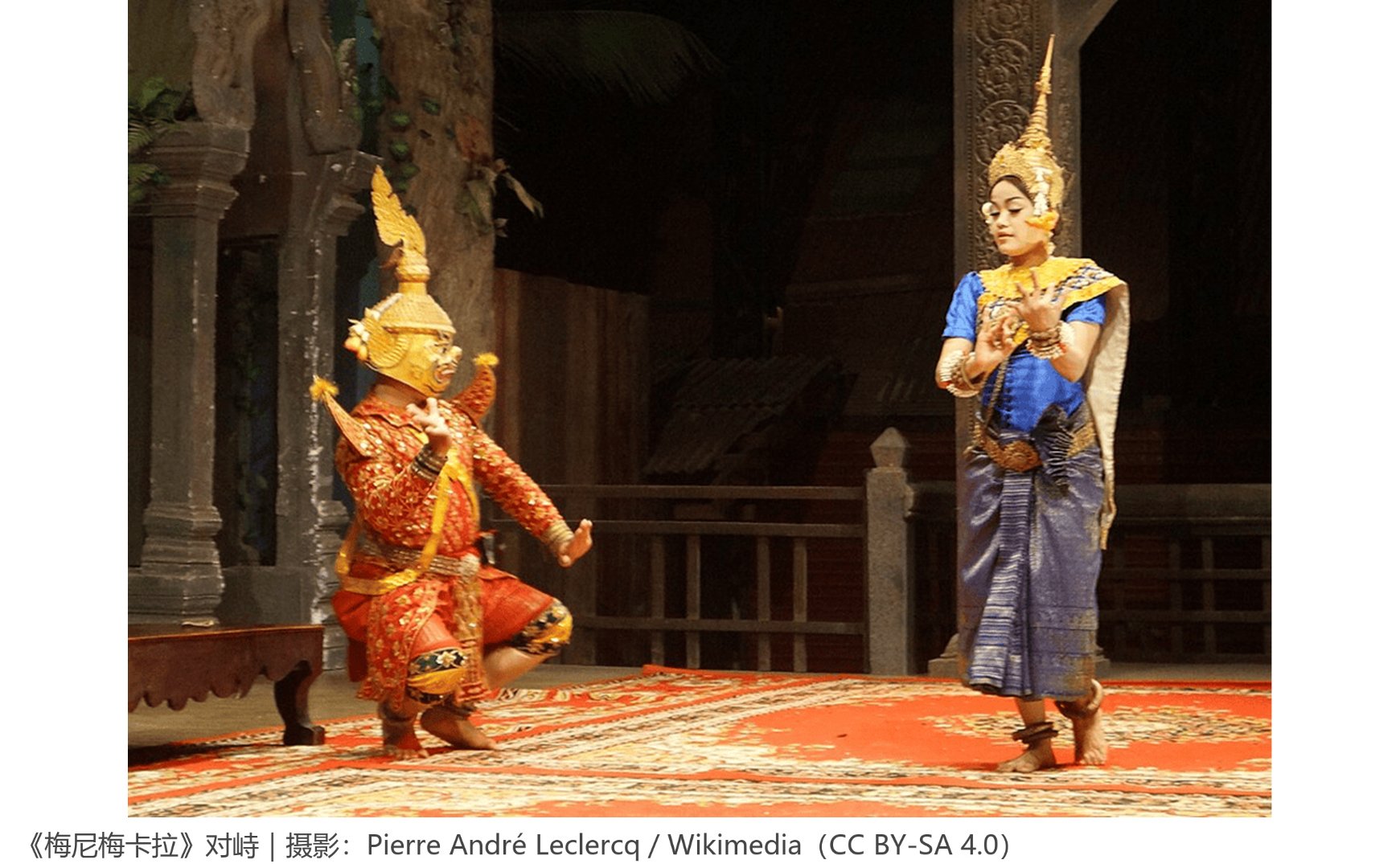
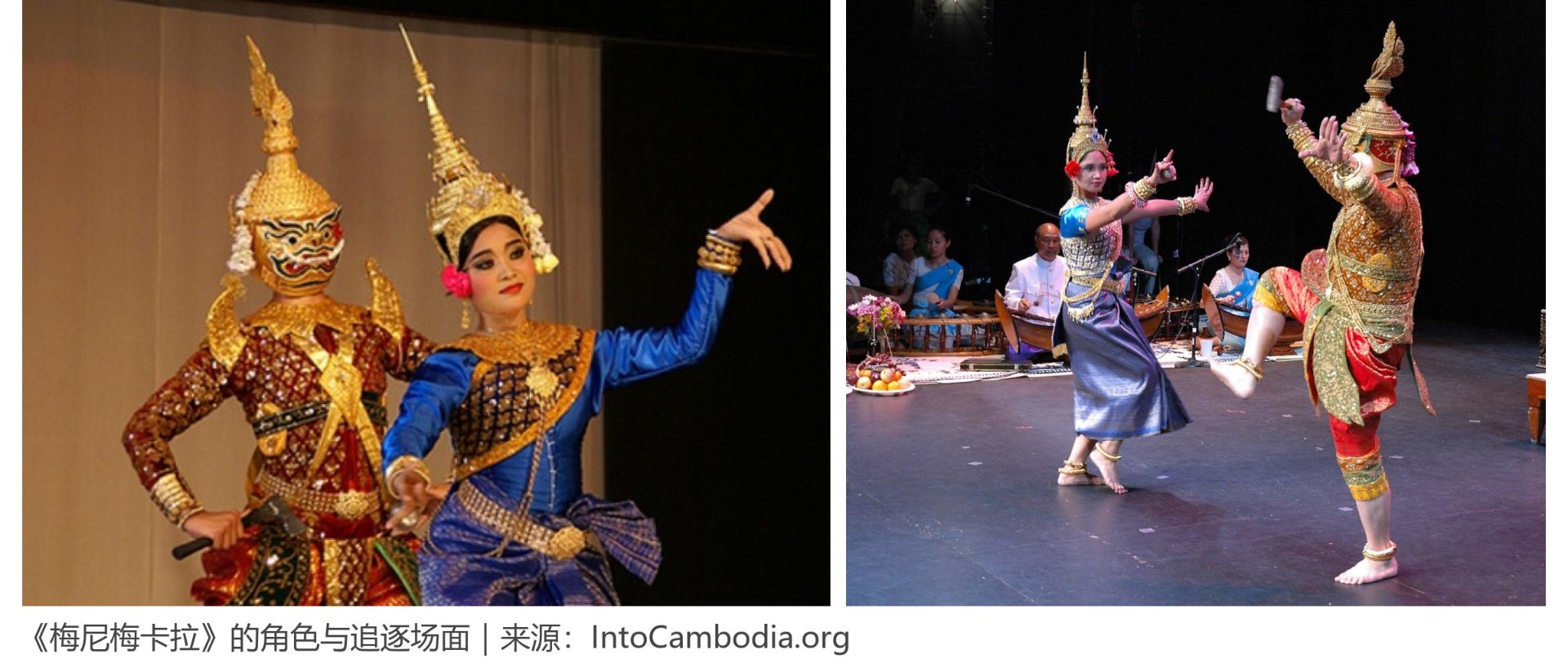
To feel this interplay, one can watch a performance of Robam Moni Mekhala. This is a classic piece in the Khmer classical dance repertoire, telling a Cambodian myth about the origins of thunder, lightning and rain, traditionally performed at rain-prayer and New Year ceremonies. In the story, the sea goddess Mekhala and an ogre were fellow students; the master awarded a precious gem to the more diligent Mekhala. The ogre, seething with envy, tried to seize it but could not, and in a fit of rage hurled his axe. The flashing light of the gem is the lightning, the thunderous crash of the axe is the thunder, and as the two chase and flee, the rain falls. When the gongs and drums suddenly tighten and the ogre strides in pursuit across the stage, that is the climax of the piece.
One Hundred and Twenty Years, from Marseille to Phnom Penh
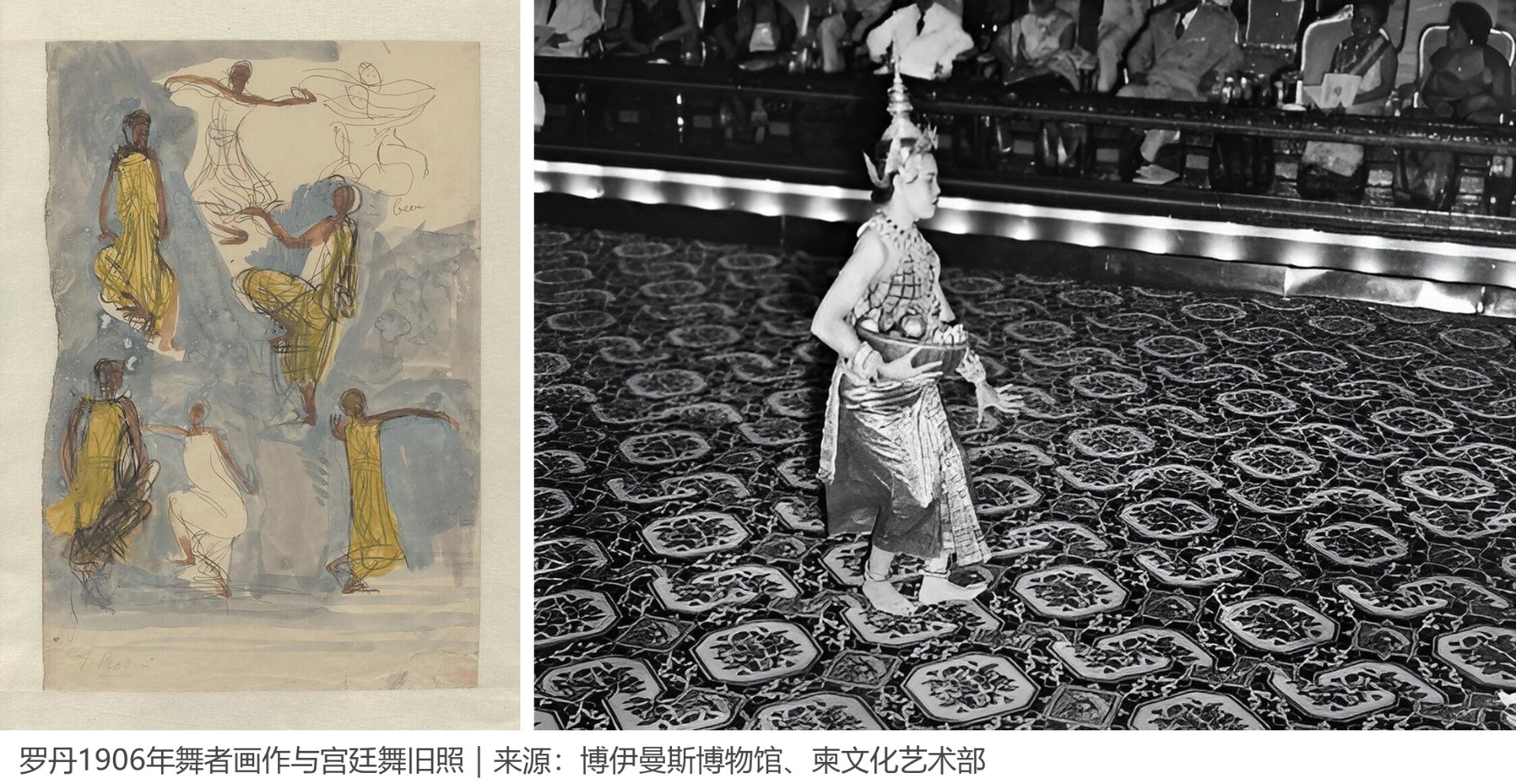
This dance first travelled abroad in 1906. That year, King Sisowath visited France to attend the colonial exposition in Marseille, and the royal ballet troupe accompanying him performed in Marseille and Paris, creating a sensation. The 66-year-old sculptor Rodin saw one of their performances in Paris and followed them all the way to Marseille, producing about one hundred and fifty sketches and watercolours of the dancers in all. When the troupe left, he said he felt that they had taken the beauty of the world away with them. But at that time Cambodia was still a French protectorate, and the people in the audience were, for the most part, watching them as an exotic spectacle of the colony.
The road that followed was not easy. The wars of the seventies of the twentieth century dealt a severe blow to the transmission of Cambodian classical dance: many veteran artists lost their lives, and the troupe's activities were interrupted for a time. Classical dance has no written notation; everything is passed on gesture by gesture from teacher to student, with the student practising along time and again. When the old artists were gone, the dances they carried went with them, and this art form once came close to being lost.
Later, the dancers returned to Phnom Penh one after another, piecing each dance back together from memory and passing it on, gesture by gesture, to a new generation of children. Princess Buppha Devi eventually returned to Cambodia and devoted the latter half of her life to this cause: leading the reconstruction of the Royal Ballet, reviving lost pieces, taking the troupe on international tours, and serving as Minister of Culture and Fine Arts. In 2003, UNESCO proclaimed the Royal Ballet of Cambodia a Masterpiece of the Oral and Intangible Heritage of Humanity, and in 2008 it was formally inscribed on the Representative List of the Intangible Cultural Heritage of Humanity. Decades of her dedication lie behind this recognition.
In November 2026, this dance stood once again before the world — this time on its own home ground. Cambodia hosted the Francophonie Summit for the first time, and on the 14th, President and Mrs. Macron arrived in Phnom Penh, where they were welcomed on the tarmac by Apsara dancers performing a traditional blessing dance. The following evening, at the gala dinner for heads of state and government, according to the Khmer Times, classical Apsara dancers took to the stage once more; after the event, the Macrons even took selfies with the dancers.
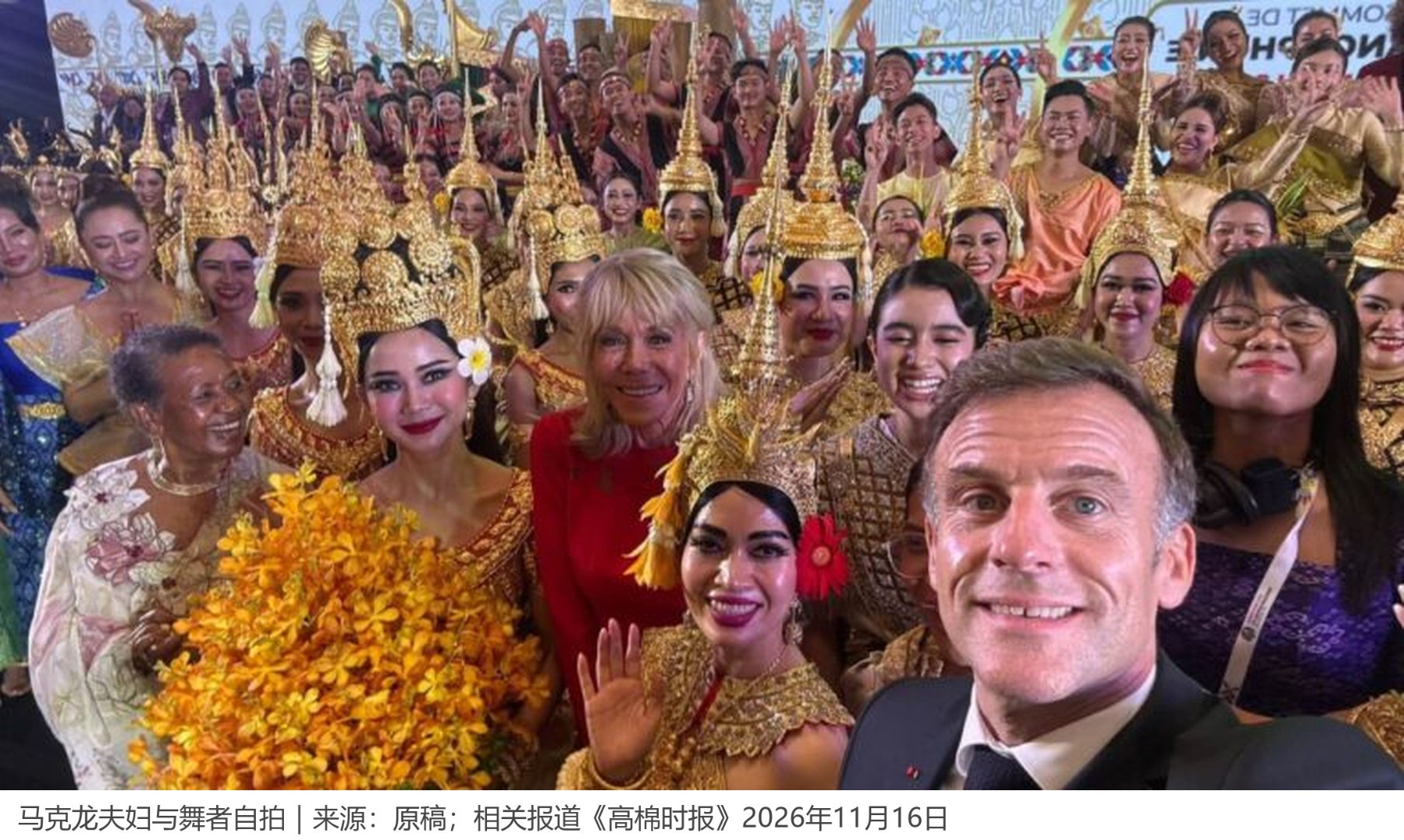
One hundred and twenty years ago, the dancers crossed the ocean with the king, to be watched at an exposition in France; one hundred and twenty years later, they stood on their own soil, as hosts, welcoming the French President and delegations from more than eighty countries and governments. From the stone walls of Angkor to the exhibition halls of Marseille and back to the tarmac in Phnom Penh, this dance has travelled a long road. Of this summit, King Norodom Sihamoni said: In 2026, the Khmer smile will become the smile of the Francophone world.
It was also at this summit that nations adopted the Phnom Penh Appeal proposed by Cambodia, whose theme was precisely the protection of cultural heritage and the promotion of cultural diversity. The appeal highlights the need to guard against the damage done to heritage by war, natural disasters and the trafficking of cultural objects, and expresses concern about the cultural homogenisation brought by the digital age. That this initiative was put forward by Cambodia carries its own weight: Cambodia's classical dance was itself once nearly broken during war, and was reclaimed piece by piece from the memories of the generation of artists who survived.
Being on the list does not mean one can rest easy from then on. Even today, classical dance still faces difficulties: insufficient funding, a shortage of suitable performance venues, and young audiences whose attention is drawn away by all kinds of new media. Some also worry that it will slowly become a show performed only for tourists. Children must still enter the practice studio from a young age, drilling a single gesture for years; and the audience also still needs people willing to sit down and watch a performance through to the end. Whether this dance can be passed on further depends not only on those who dance on stage, but also on those who watch from the audience.
Where to Watch, and What to Watch For
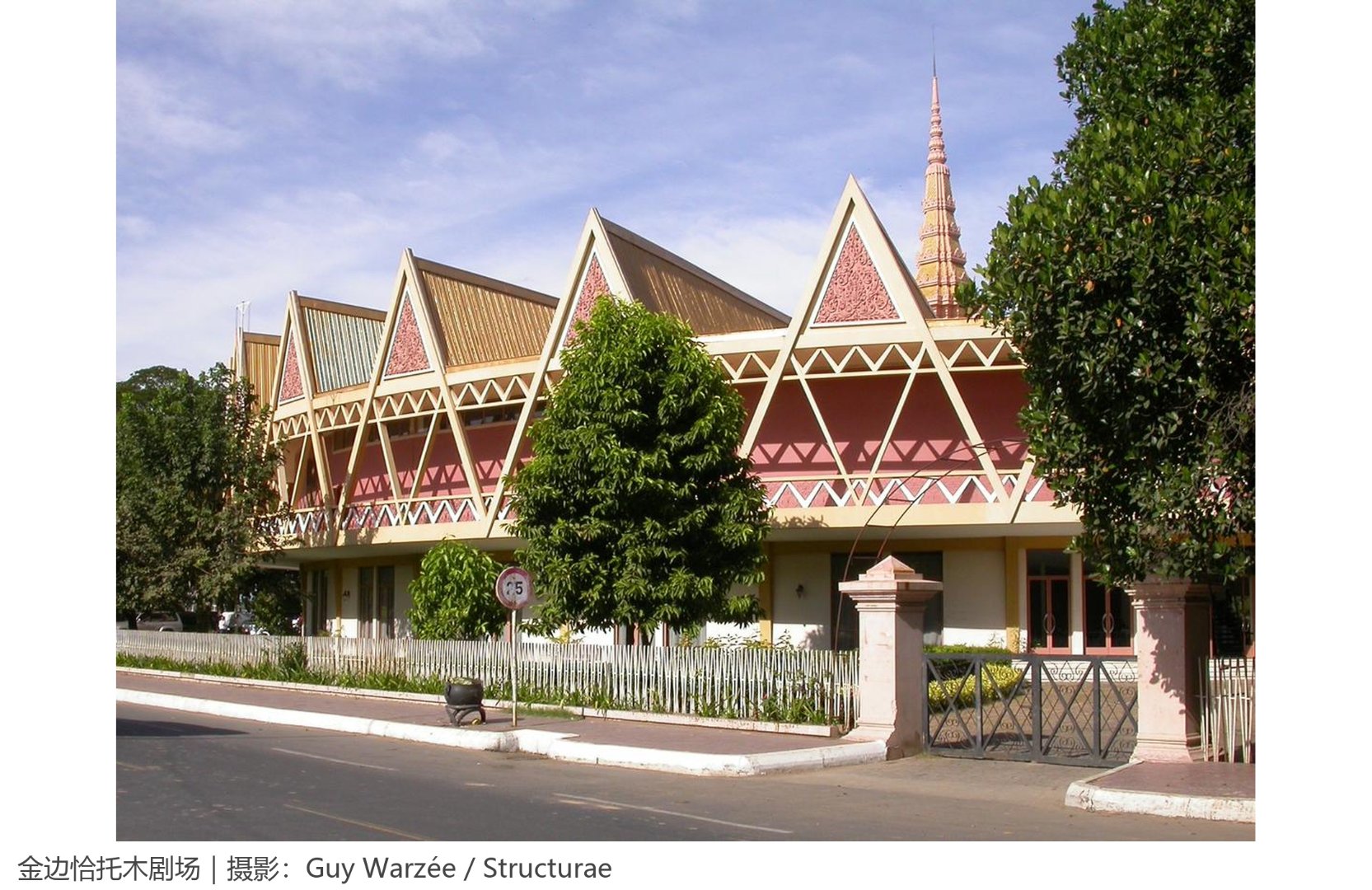
To see authentic Khmer classical dance, it is best to look for official performances. In Phnom Penh, Royal Ballet performances organised by the Ministry of Culture and Fine Arts and its affiliated arts schools are mostly held at the Chaktomuk Theatre. This theatre is a signature cultural landmark of Phnom Penh; for important premieres, the King may even attend in person. Official performances are not held every day, and announcements are released on the Ministry of Culture and Fine Arts website (mcfa.gov.kh) and its social media; it is wise to check before setting out.
It does not matter if you do not understand Khmer or have not done any homework in advance. On your first viewing, three things are enough to watch for:
• Watch the hands: look for the tree, leaf, flower and fruit gestures, and see how they flow into one another.
• Recognise the characters: the masked one walking in long strides is the ogre, the one leaping and bounding is the monkey, and the one with the gentlest movements is the female role.
• Wait for the pauses: in those few seconds when the dancer holds still, don't be in a hurry to look down at your phone — that is when they most resemble the celestial maidens on the stone walls.
It does not matter if you do not follow the story. If you find it beautiful, you have already understood half.
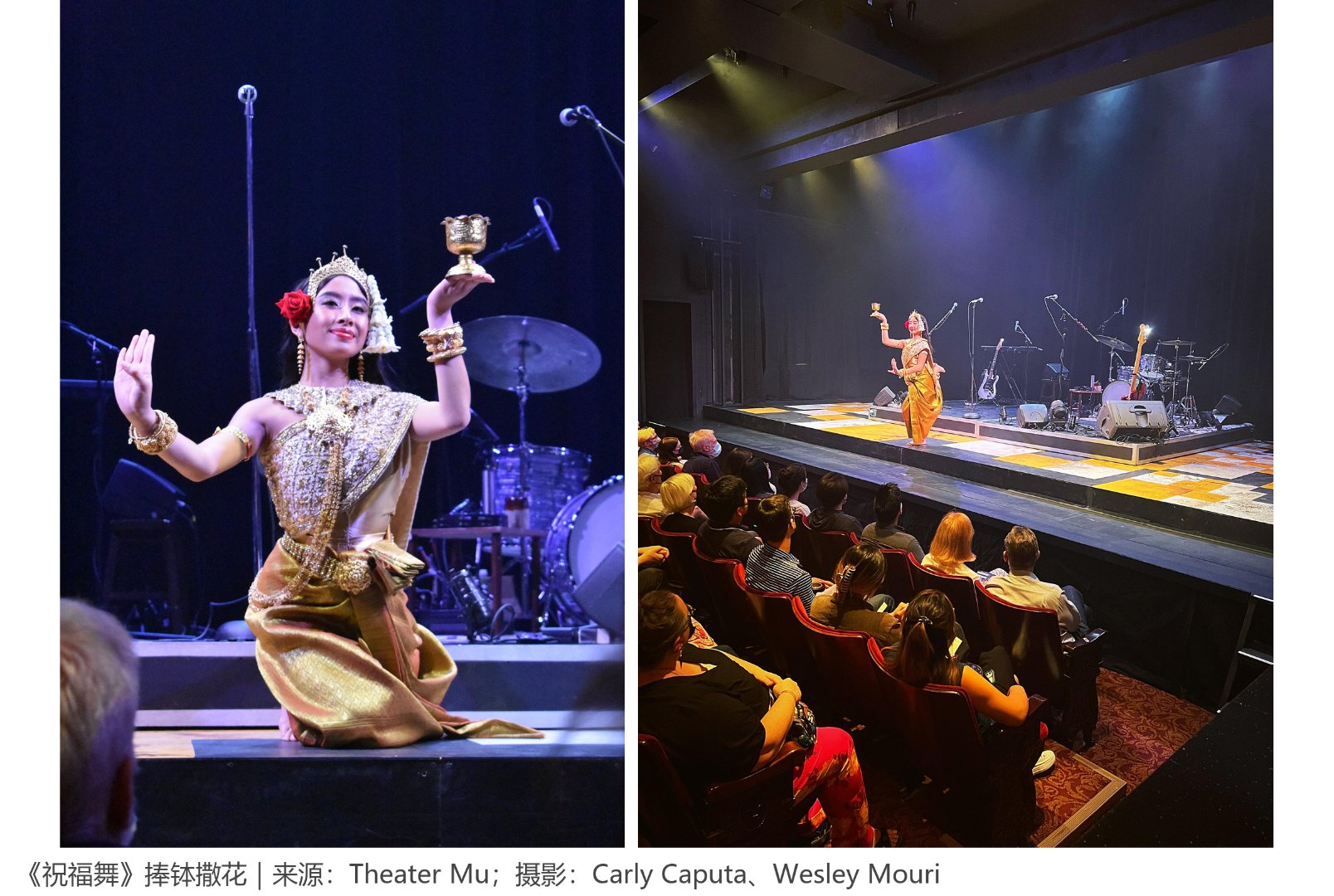
Many performances and celebrations open with the Blessing Dance (Robam Chuon Por). This dance is also the work of Queen Kossamak: the dancers hold golden bowls of flowers and scatter the petals one by one over the audience. In the eyes of the Khmer, these are blessings from the heavens settling on every member of the audience. Offering the finest wishes to guests first — this is the Khmer way of hosting, and it is the heart of this dance that has remained unchanged through all these years.
From the carved celestial maidens in the galleries of Angkor to ceremonies deep within the royal palace; from the exhibition halls of Marseille in 1906 to today's theatres in Phnom Penh, this dance has been performed for nearly a thousand years. It once almost disappeared, and was brought back by one generation after another. Today it is no longer performed only for gods and kings; those sitting in the audience may be local children, or strangers setting foot in Cambodia for the first time.
Children just beginning to learn dance start with the four gestures of tree, leaf, flower and fruit. The fruit falls into the earth, and a new tree grows. This dance has been passed down in just this way: the teacher hands the gestures to the student, and the student, when grown, hands them on to the next child. The dancer on stage is the fruit of this cycle; the petals drifting out over the audience are like seeds scattered into the world.
When the next petal falls, who will catch it?
References and Image Sources
Online sources accessed: 20 November 2026. Click an entry title to open the source.
Textual Sources and Related Images
[1] UNESCO: Royal ballet of Cambodia
Overview of the Royal Ballet, its ceremonial function, its 2003 proclamation as a masterpiece, and 2008 inscription on the Representative List.
[2] Ministry of Culture and Fine Arts of Cambodia: Royal Ballet of Cambodia
Roles, gestures, costumes, the pinpeat orchestra, and dance photographs published on the official website.
[3] French Cultural Centre and UNESCO Cambodia Office: Le Ballet Royal (c. 2004; archived by the Angkor Database)
Background on the history of the Royal Ballet, Princess Buppha Devi, and artistic transmission.
[4] Musée Rodin, France: Rodin and the Cambodian Dancers (2006 exhibition)
The Royal Ballet's 1906 visit to France and Rodin's depictions of the dancers.
[5] Prumsodun Ok / TED2017: The magic of Khmer classical dance
Demonstration of the four gestures — tree, leaf, flower, fruit; close-up gesture images in this article are taken from the talk video.
[6] IntoCambodia.org: Moni Mekhala Dance
The myth of Moni Mekhala, its characters, the gem and the axe, and photographs of the characters and the chase scene.
[7] Kuwait Times: Difficult dance: Cambodian tradition under threat (5 January 2026)
The state of dance teaching and transmission; photos of students practising, teachers instructing, and pre-performance dressing.
[8] Theater Mu: Wattanak Dance Troupe at opening night of Cambodian Rock Band (10 June 2022)
The Blessing Dance's bowl-holding and petal-scattering movements and accompanying images; photography by Carly Caputa and Wesley Mouri.
[9] Élysée, Office of the President of France: State Visit to Cambodia and Francophonie Summit (16 November 2026)
Background on Macron's visit to Cambodia and attendance at the Francophonie Summit.
[10] Organisation internationale de la Francophonie (OIF): Appel de Phnom Penh (Phnom Penh Appeal)
Original text of the initiative on protecting cultural heritage and promoting cultural diversity.
[11] Khmer Times: In Pictures: President Macron and wife charmed by traditional Khmer dancers (16 November 2026)
Reporting on the Macrons taking selfies with the traditional dancers.
Supplementary Image Sources
[12] Museum Boijmans Van Beuningen: Seven Cambodian Female Dancers (1906)
Rodin's Seven Cambodian Female Dancers; collection number F II 111 (PK).
[13] National Heritage Board of Singapore, Roots: Mask of Sugrib, the Monkey King
Photograph of the mask of Sugrib, the monkey king.
[14] National Heritage Board of Singapore, Roots: Mask of Krong Reap, an ogre
Photograph of the mask of Krong Reap, the ogre.
[15] Tim Jules Hull / Globaltimoto: Pinpeat orchestra plays traditional Khmer music
On-site photo of a pinpeat orchestra performing in Siem Reap.
[16] Pierre André Leclercq / Wikimedia Commons: Siem-Reap Dance of Cambodia (13)
Photograph of the Moni Mekhala confrontation; CC BY-SA 4.0, with added Chinese caption.
[17] Guy Warzée / Structurae: Chaktomuk Theatre (Media ID 133187)
Exterior photograph of the Chaktomuk Theatre, taken in 2008.
[18] Images provided with the original manuscript: Apsara group dance, portrait collage of Princess Buppha Devi, dance-drama group shots, and some stone carvings, costumes, and old photos of court dancers; photography credits as indicated in the images.