February 2, 2026 is Meak Bochea, a full-moon Buddhist observance with significance comparable to Visak Bochea, Asalha Bochea and Pavarana at the end of the rains retreat. Why is this day observed?
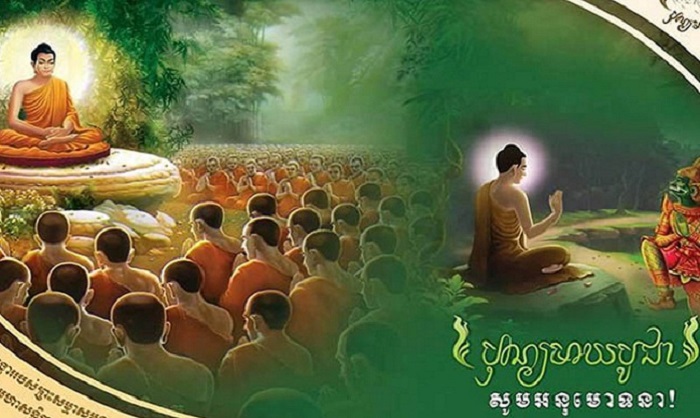
In the Buddhist traditional account presented here, the day celebrates the Buddha's proclamation and establishment of Buddhism in India in 588 BCE, on the fifteenth waxing day of the month of Magha, exactly nine months after his awakening. It recalls the organisation of the religion through an assembly of 1,250 monks drawn from all castes.
The Buddha set out eleven principles known as the Ovada Patimokkha, a path for the assembly to live by and teach others. Patimokkha is the Pali name for the prescribed monastic training rules recited fortnightly, serving as material for learning and recitation. All Buddhists should study, understand and practise the teaching.
Meak Bochea commemorates three great events.
They are the fourfold assembly, the delivery of the Ovada Patimokkha and the Buddha's relinquishment of his life force.
First event: an assembly with four conditions.
At Veluvana, the first Buddhist monastery, the Buddha delivered the Ovada Patimokkha to an assembly marked by four concurrent circumstances:
1. The 1,250 missionary monks whom he had sent to different regions returned together: sabbe khinasava.
2. All had been directly ordained by the Buddha through ehibhikkhu-upasampada: sabbe ehibhikkhuka.
3. All were arahants possessing six higher knowledges: psychic powers, the divine ear, the divine eye, knowledge of others' minds, recollection of past lives and the destruction of the taints. They gathered without being invited: sabbe animantita.
4. It was the full moon of Magha: Magha-nakkhatte punnacando. The assembly took place at Veluvana in Rajagaha, Magadha, under King Bimbisara, nine months after the Buddha's awakening and 45 years before the Buddhist Era.
Second event: the Ovada Patimokkha teaching.
Taking the unexpected and wondrous gathering as an opportunity, the Buddha taught the 1,250 monks and set out five aspects of the teaching's policy. The terms in parentheses below are the exposition's modern analogies.
1. Ideal: patience as steadfast perseverance (political forgiveness or amnesty).
2. Goal: Nibbana, Buddhism's highest goal (the public interest).
3. Practice: not violating the rights of humans or animals (human rights).
4. Three principles:
Do no evil (security).
Do good fully (social benefit).
Purify one's own mind (self-development).
5. Six methods:
Do not defame anyone: upright speech is gentle, truthful, non-divisive and considered (public communication and outreach).
Do not harass or persecute others (non-violence and peaceful means).
Respect the ethical code (ethics).
Be moderate in eating (economics).
Sit and sleep in solitude (urbanisation).
Strive for the higher mind, adhicitta (education).
Third event: relinquishment of the life force.
According to the traditional account, when the Buddha was 80, three months before his parinibbana, Mara urged him to enter Nibbana on the full moon of Magha. The Buddha said he would do so three months later, on the full moon of Visakha. This illustrates impermanence: no being is immortal, and even an awakened Buddha enters parinibbana.
The account says earthquakes and thunder occurred when he relinquished his life force. Thus, the Magha full moon recalls two wondrous occasions: the assembly of arahants and the relinquishment of the life force. Buddhists have traditionally brought offerings to the Triple Gem—the Buddha, Dhamma and Sangha—to mark the anniversary.
By: Nget Pisant.