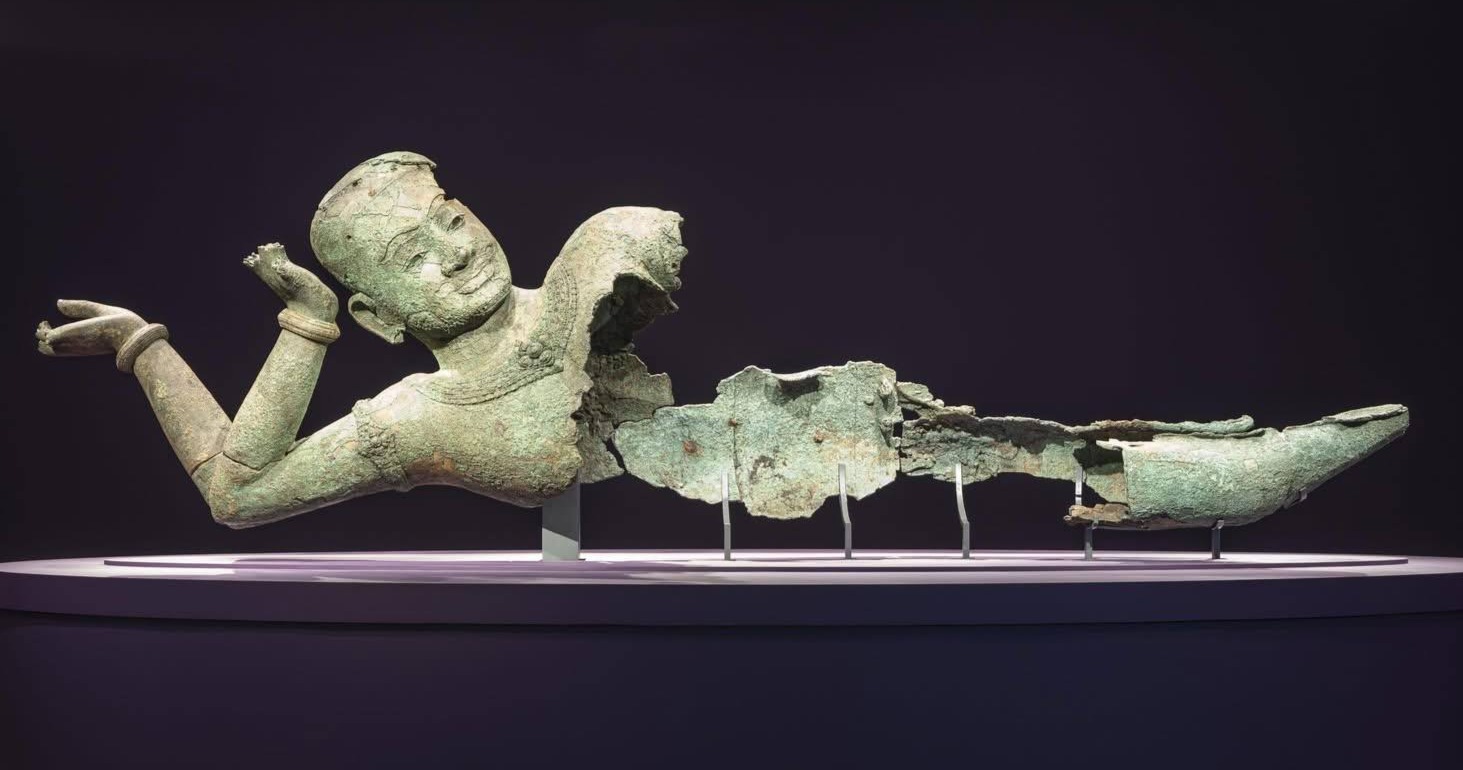
The Asian Art Museum in San Francisco, the United States, launched the exhibition “Vishnu’s Cosmic Ocean” on October 23, running through January 25, 2027. The centerpiece is a nearly millennium-old bronze reclining statue of Vishnu from Cambodia’s Angkor period, measuring approximately 6 meters long. After the exhibition, the important cultural relic will conclude its overseas tour and return to Cambodia.
Chhay Visoth, director of the National Museum of Cambodia, said the reclining statue is one of Cambodia’s most important bronze artworks and that the San Francisco exhibition may be the last opportunity for overseas audiences to see it outside Cambodia.
The statue was discovered underground at the ruins of West Mebon temple in Siem Reap province in 1936. Beginning in 2025, it was exhibited in Paris, Minneapolis and Washington, D.C. During its Paris exhibition, experts also examined, studied and restored the statue.
West Mebon temple is located on the central island of West Baray Lake in the Angkor Archaeological Park. Built in the 11th century, it reflects the ancient Khmer civilization’s history of combining hydraulic engineering with religious architecture. After nearly 14 years of restoration, the temple is expected to be formally inaugurated in November this year.
The Asian Art Museum in San Francisco will also hold a specialized lecture on November 1 exploring the connections among Angkor-era hydraulic construction, state governance and Hindu cosmic-ocean mythology. The exhibition is the final stop before the relic returns to its homeland and gives international audiences a further opportunity to understand Cambodia’s history and art.