On 14 May 2026, Myanmar’s state newspaper The Mirror published an anti-online scam bill for the public to study and comment on. The published text is a draft bill.
Section 47 of the bill would prohibit anyone from using violence, torture, unlawful detention or cruel treatment against another person for the purpose of committing an online scam.
Under proposed section 54, a person convicted of violating section 47 would be sentenced to imprisonment for 10 years to life, or to death, and could also be fined.
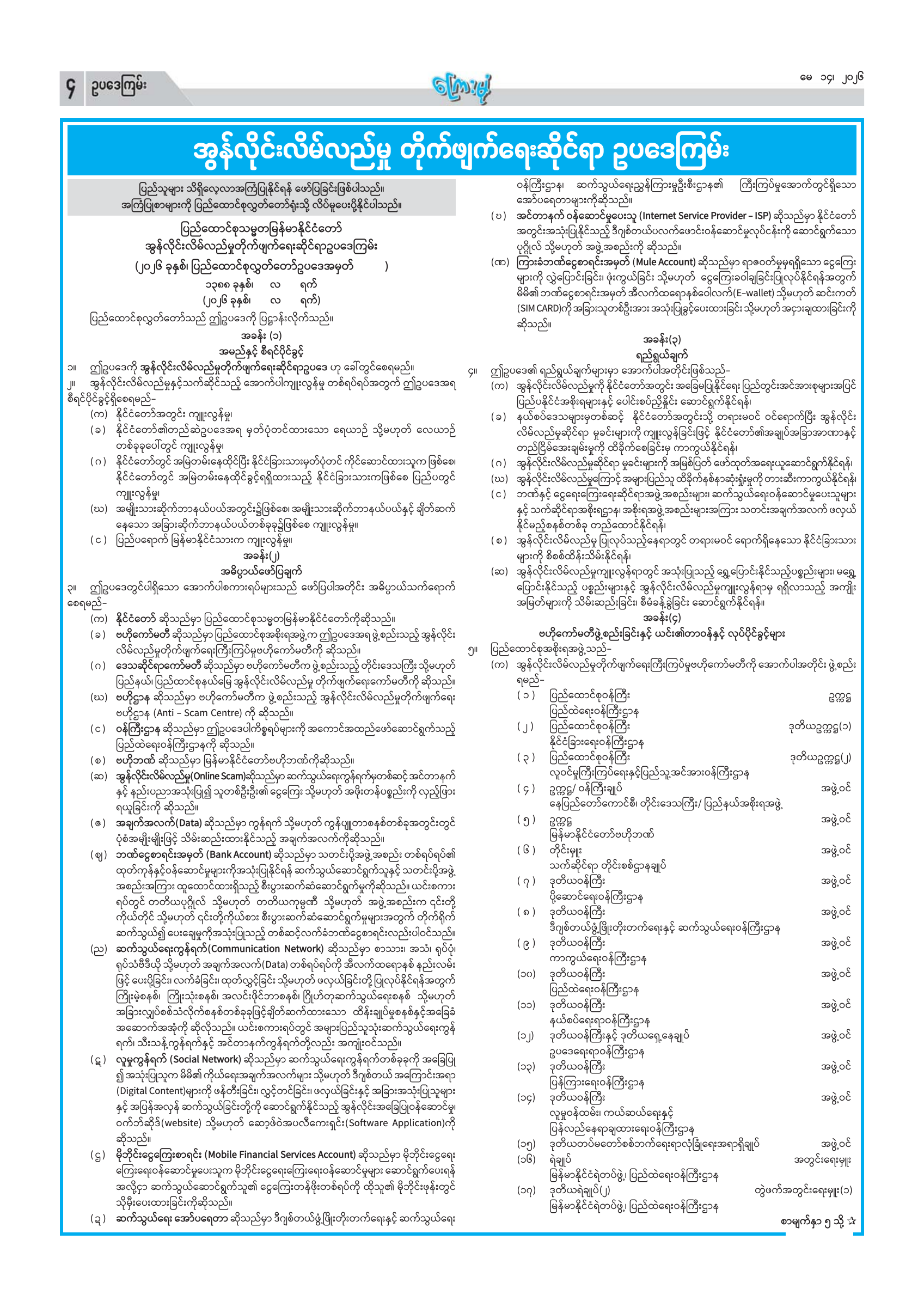 First page of the anti-online scam bill published on page 4 of Myanmar’s The Mirror on 14 May 2026. Source: the original newspaper PDF on Myanmar’s Ministry of Information website. The document is a draft bill. Original PDFSection 2 of the bill sets out the following grounds for jurisdiction: An act committed within Myanmar; an act committed aboard a vessel or aircraft registered under Myanmar’s existing laws; an act committed abroad by a person permanently residing in Myanmar who holds a foreigner registration certificate, or by a foreign national granted permanent residence in Myanmar; an act committed in the national cyberspace or another cyberspace connected to it; and an act committed by a Myanmar citizen abroad. The provision concerning foreign nationals contains specific connecting conditions and should not be read as applying to everyone holding foreign documents, wherever they are.
For other penalties, proposed section 51 provides that a person convicted of violating section 31, 34, 35 or 49 would be sentenced to one to three years in prison and could also be fined 10 million to 50 million kyats.
Proposed section 52 provides three to seven years in prison, with a possible additional fine of 50 million to 100 million kyats, for a person convicted of violating section 32, 33, 36, 37, 38, 39, 40, 41, 42 or 43. Proposed section 53 provides 10 years to life in prison, with a possible additional fine, for a person convicted of violating section 44, 45, 46 or 48.
Section 54 further proposes a mandatory death sentence if the commission of the offence violating section 47 causes a person’s death. This condition is tied to the specific conduct prohibited by section 47. It does not justify omitting the elements of the offence or the requirement for conviction, or saying that every online scam involving a death automatically leads to a death sentence.
The newspaper states that members of the public may send their recommendations on the bill to the Office of the Pyidaungsu Hluttaw, the Union Parliament. That invitation does not establish that the bill has been enacted or entered into force.
The bill published on 14 May leaves the law number and enactment date blank. Its penalties should therefore be described as proposed provisions.