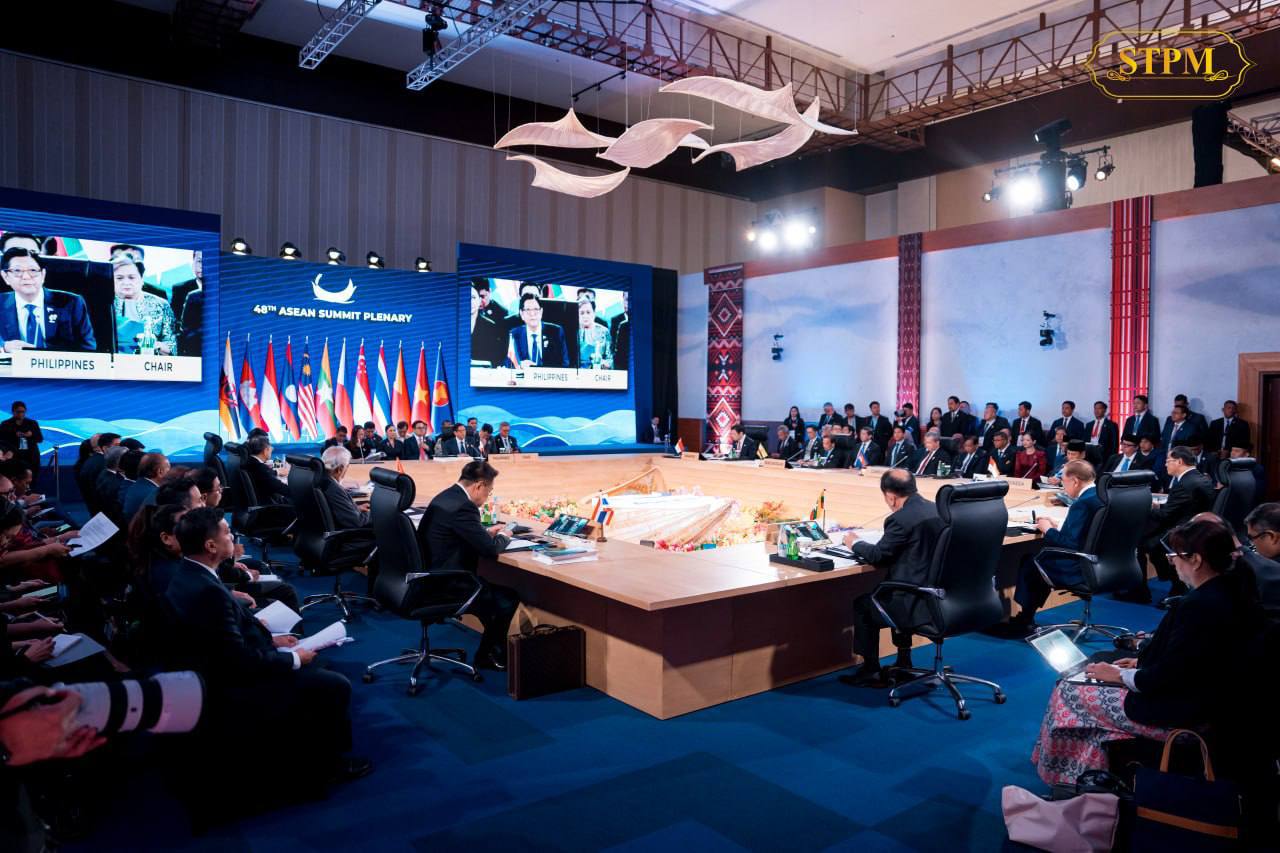
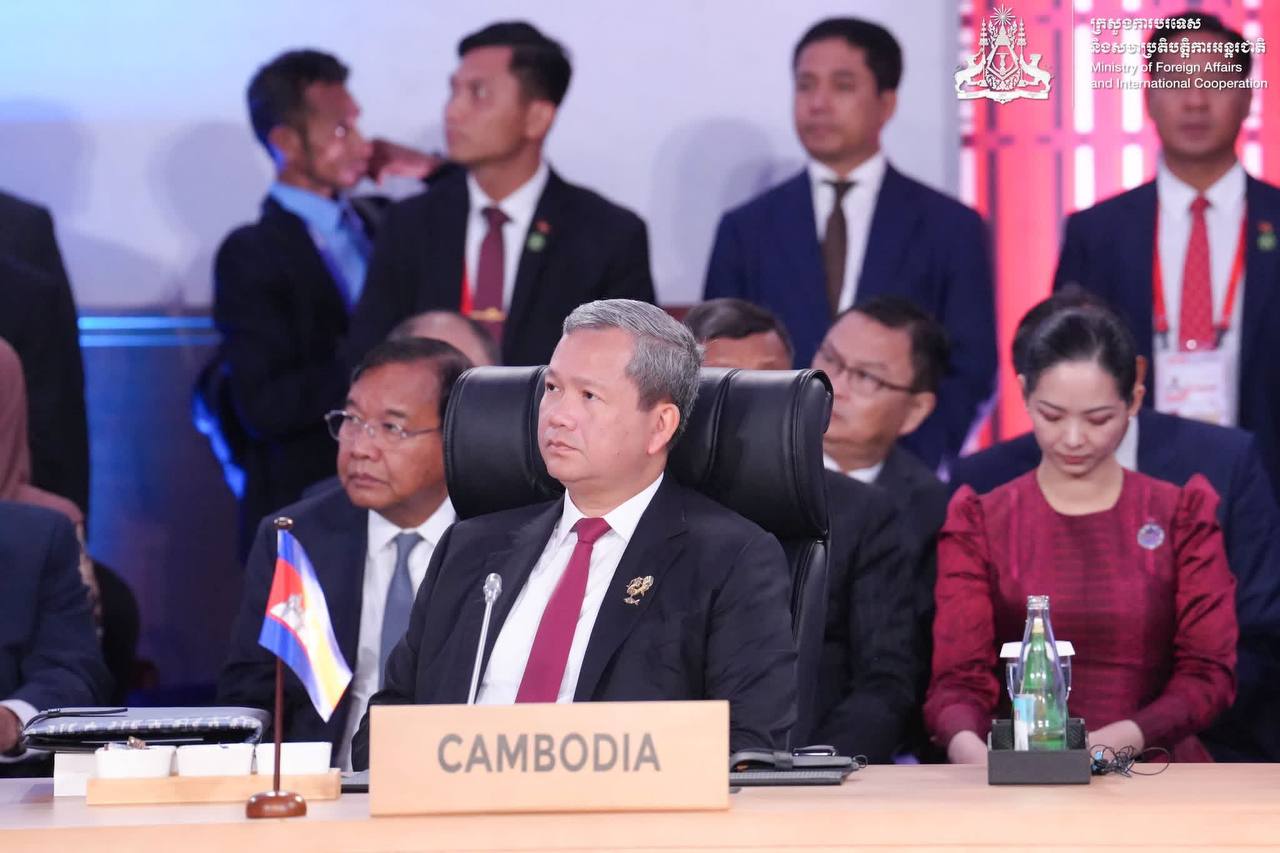
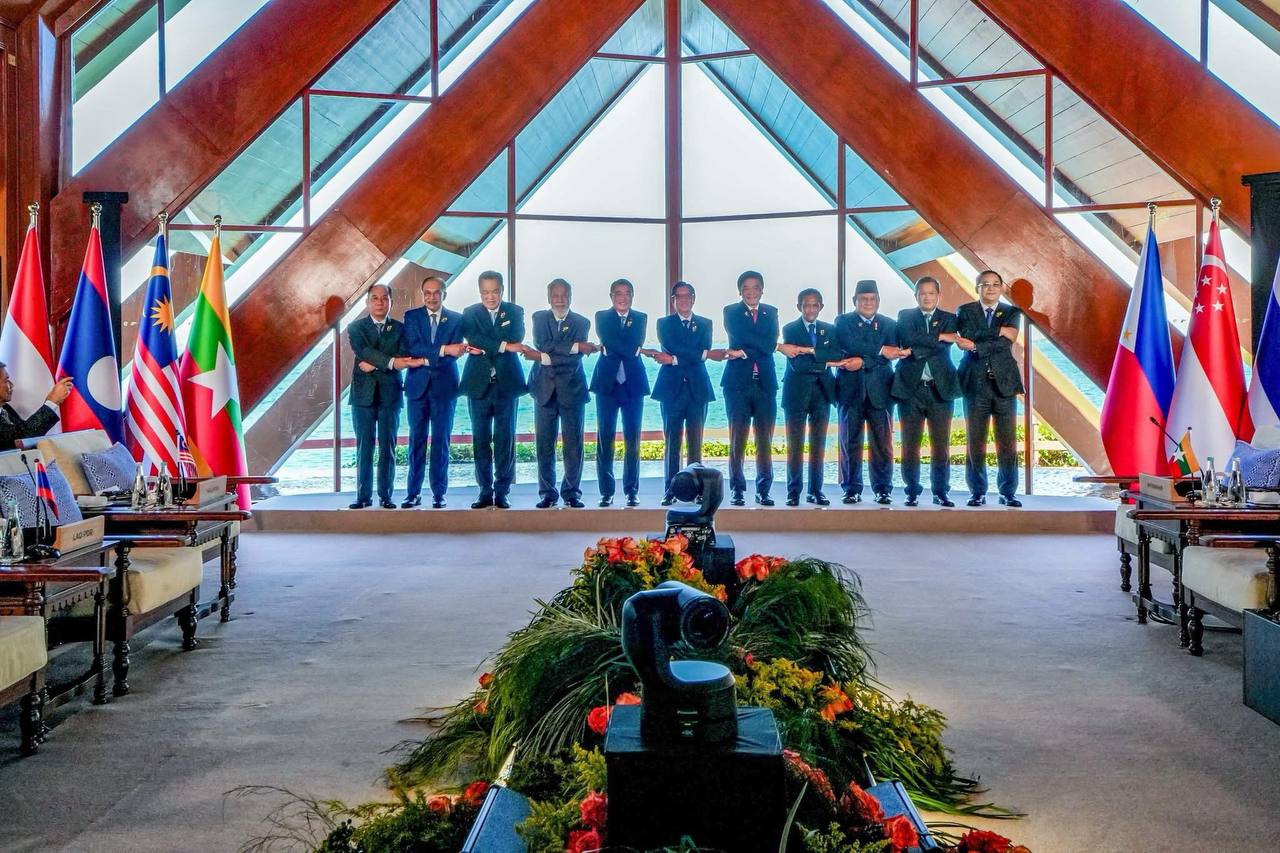
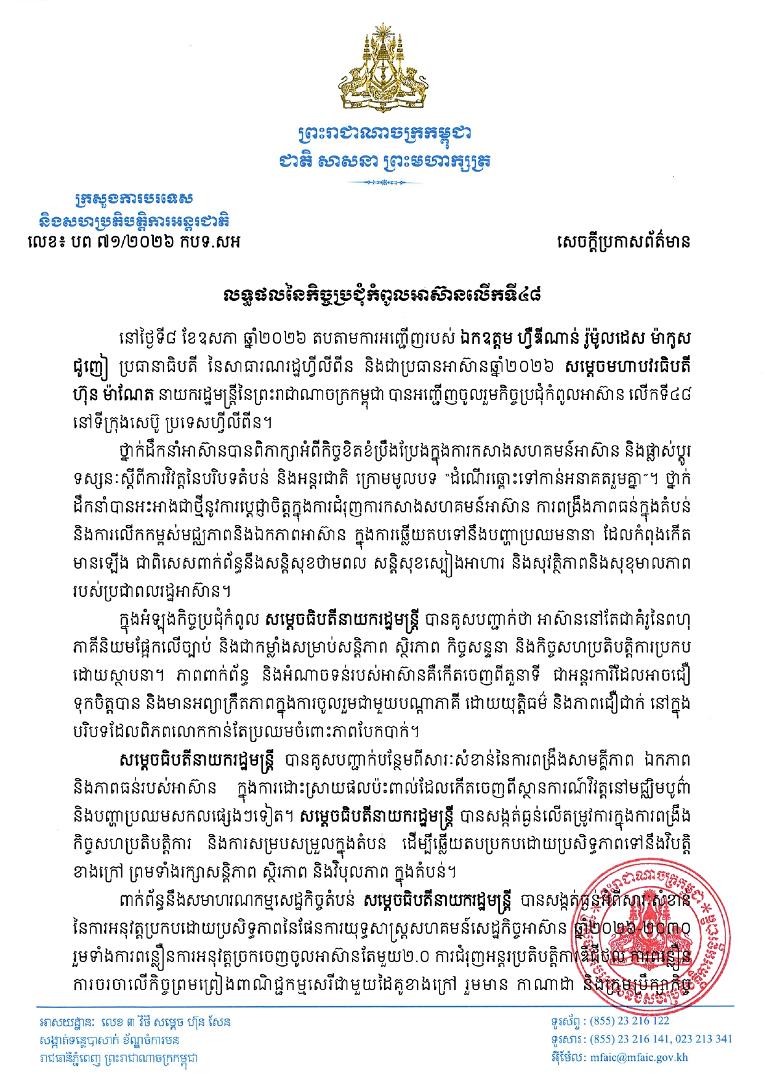
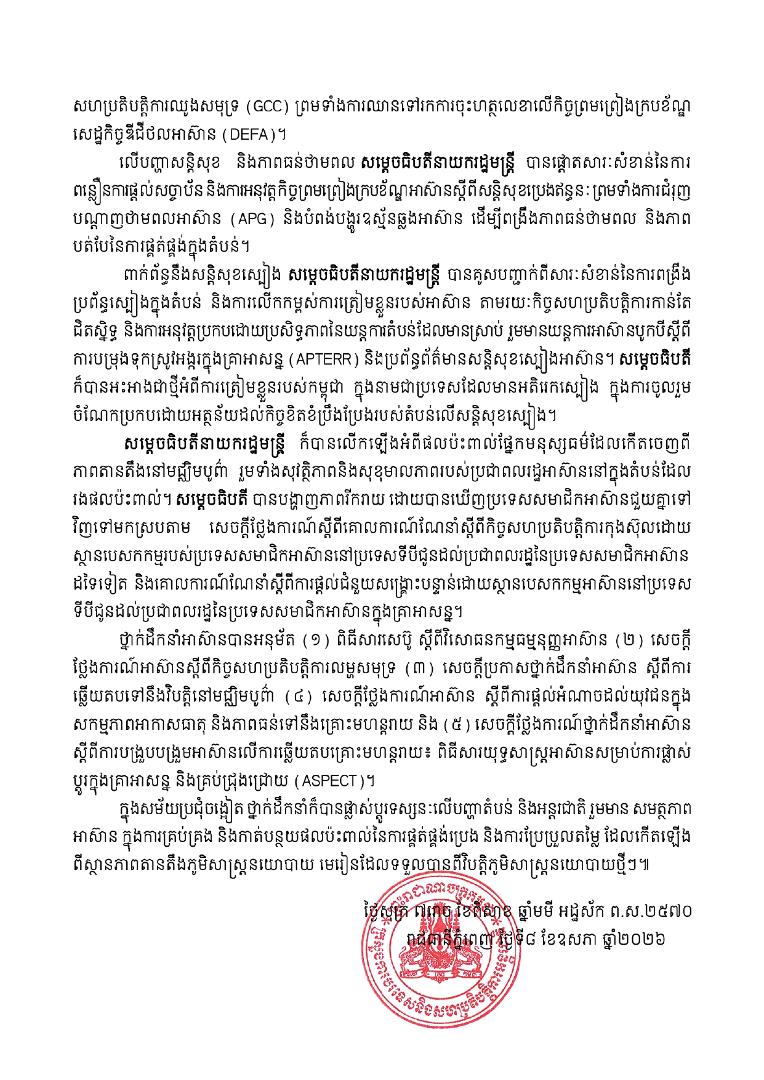
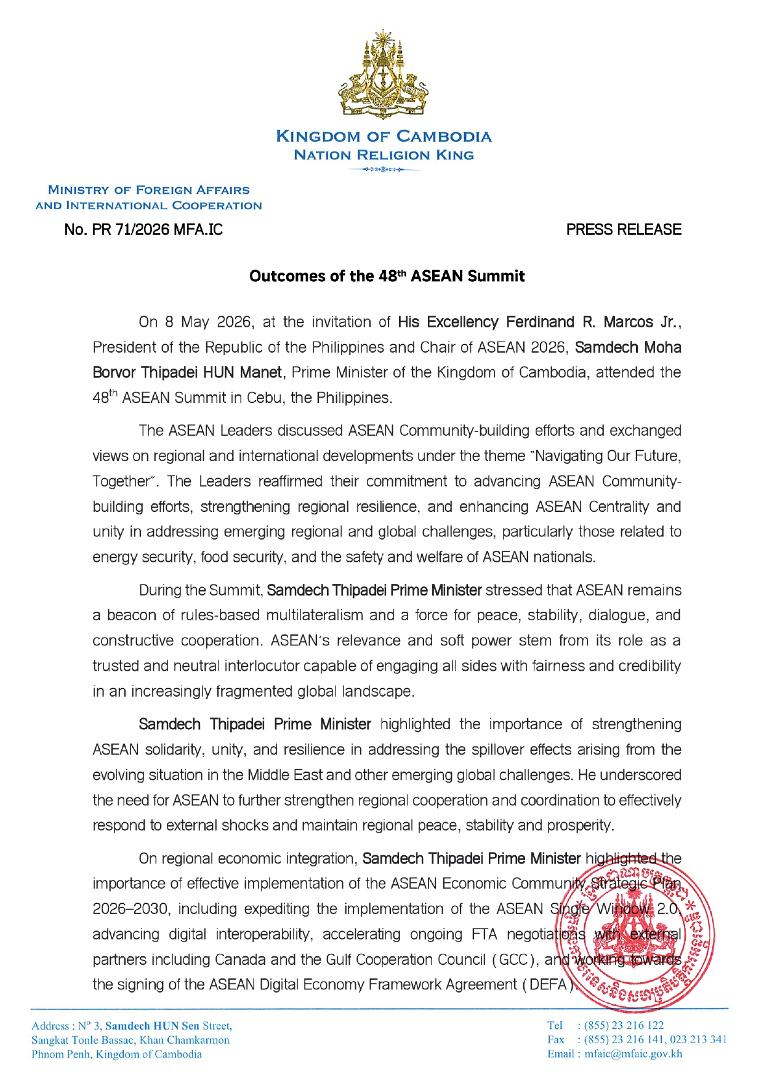
Cambodia’s Ministry of Foreign Affairs and International Cooperation issued a release on May 8 outlining the outcomes of the 48th ASEAN Summit. It said Cambodian Prime Minister Hun Manet attended the summit in Cebu, the Philippines, on May 8, 2026, at the invitation of Philippine President and ASEAN Chair for 2026 Ferdinand R. Marcos Jr.
ASEAN leaders discussed community-building and exchanged views on regional and international developments under the theme “Navigating Our Future, Together”. They reaffirmed their commitment to advancing ASEAN Community-building, strengthening regional resilience, and enhancing ASEAN centrality and unity in addressing emerging regional and global challenges, particularly energy security, food security, and the safety and welfare of ASEAN nationals.
The release said Hun Manet stressed that ASEAN remained a beacon of rules-based multilateralism and a force for peace, stability, dialogue and constructive cooperation. He said ASEAN’s relevance and soft power came from its role as a trusted, neutral interlocutor able to engage all sides fairly and credibly in an increasingly fragmented world.
He highlighted the importance of ASEAN solidarity, unity and resilience in addressing spillover effects from the evolving Middle East situation and other emerging global challenges. He called for stronger regional cooperation and coordination to respond effectively to external shocks and maintain regional peace, stability and prosperity.
On regional economic integration, he highlighted effective implementation of the ASEAN Economic Community Strategic Plan 2026–2030, including accelerating the ASEAN Single Window 2.0, advancing digital interoperability, speeding up ongoing free trade agreement negotiations with external partners including Canada and the Gulf Cooperation Council (GCC), and working towards signing the ASEAN Digital Economy Framework Agreement (DEFA).
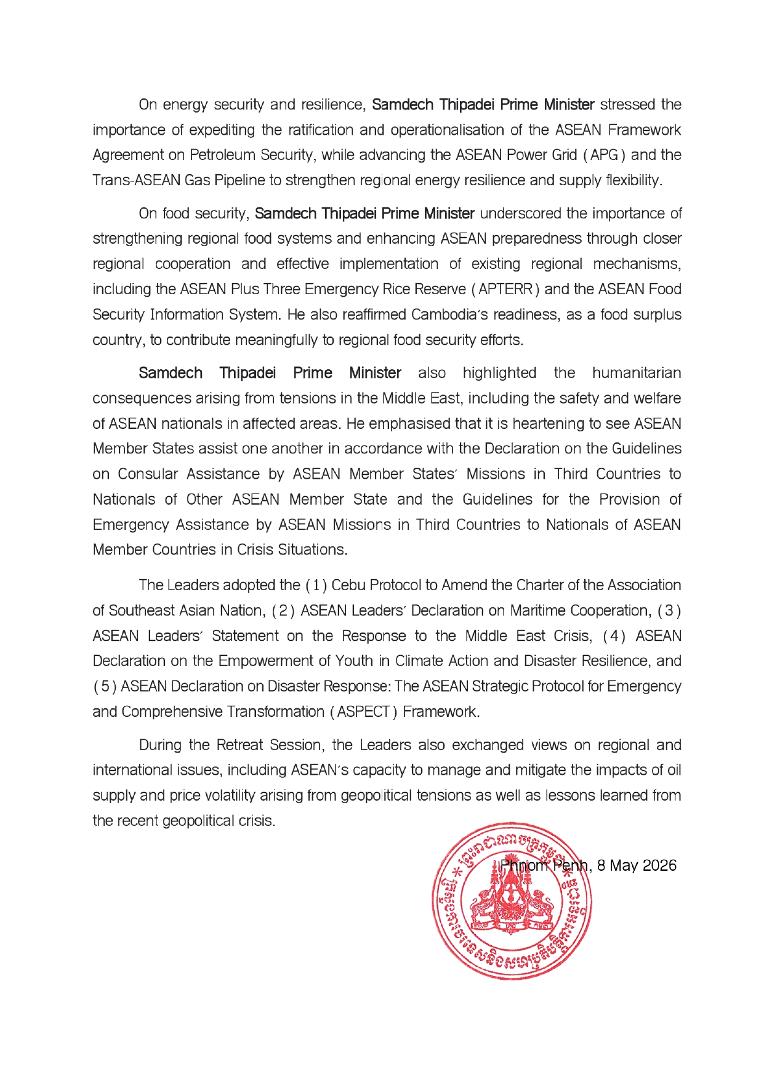
On energy security and resilience, he stressed faster ratification and operationalisation of the ASEAN Framework Agreement on Petroleum Security, while advancing the ASEAN Power Grid (APG) and the Trans-ASEAN Gas Pipeline to strengthen regional energy resilience and supply flexibility.
On food security, he stressed stronger regional food systems and better ASEAN preparedness through closer regional cooperation and effective use of existing mechanisms, including the ASEAN Plus Three Emergency Rice Reserve (APTERR) and the ASEAN Food Security Information System. He reaffirmed Cambodia’s readiness, as a food-surplus country, to contribute meaningfully to regional food security.
He also highlighted humanitarian consequences arising from tensions in the Middle East, including the safety and welfare of ASEAN nationals in affected areas. He welcomed member states’ mutual assistance under the Declaration on the Guidelines on Consular Assistance by ASEAN Member States’ Missions in Third Countries to Nationals of Other ASEAN Member States and the Guidelines for the Provision of Emergency Assistance by ASEAN Missions in Third Countries to Nationals of ASEAN Member Countries in Crisis Situations.
Leaders adopted five documents: (1) the Cebu Protocol to Amend the Charter of the Association of Southeast Asian Nations; (2) the ASEAN Leaders’ Declaration on Maritime Cooperation; (3) the ASEAN Leaders’ Statement on the Response to the Middle East Crisis; (4) the ASEAN Declaration on the Empowerment of Youth in Climate Action and Disaster Resilience; and (5) the ASEAN Declaration on Disaster Response: the ASEAN Strategic Protocol for Emergency and Comprehensive Transformation (ASPECT) Framework.
During the retreat session, leaders also exchanged views on regional and international issues, including ASEAN’s capacity to manage and mitigate the effects of oil supply and price volatility arising from geopolitical tensions, and lessons from the recent geopolitical crisis. The release was dated Phnom Penh, May 8, 2026.