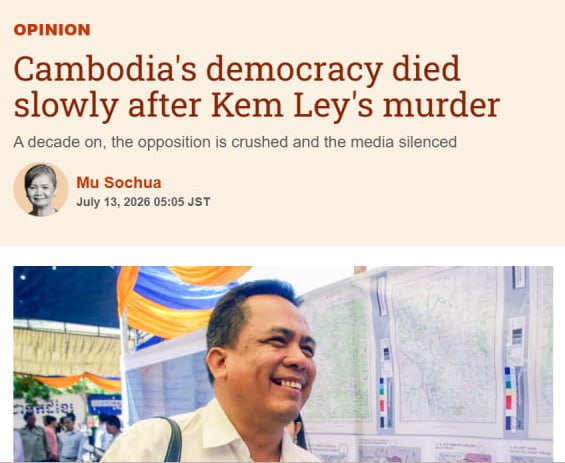
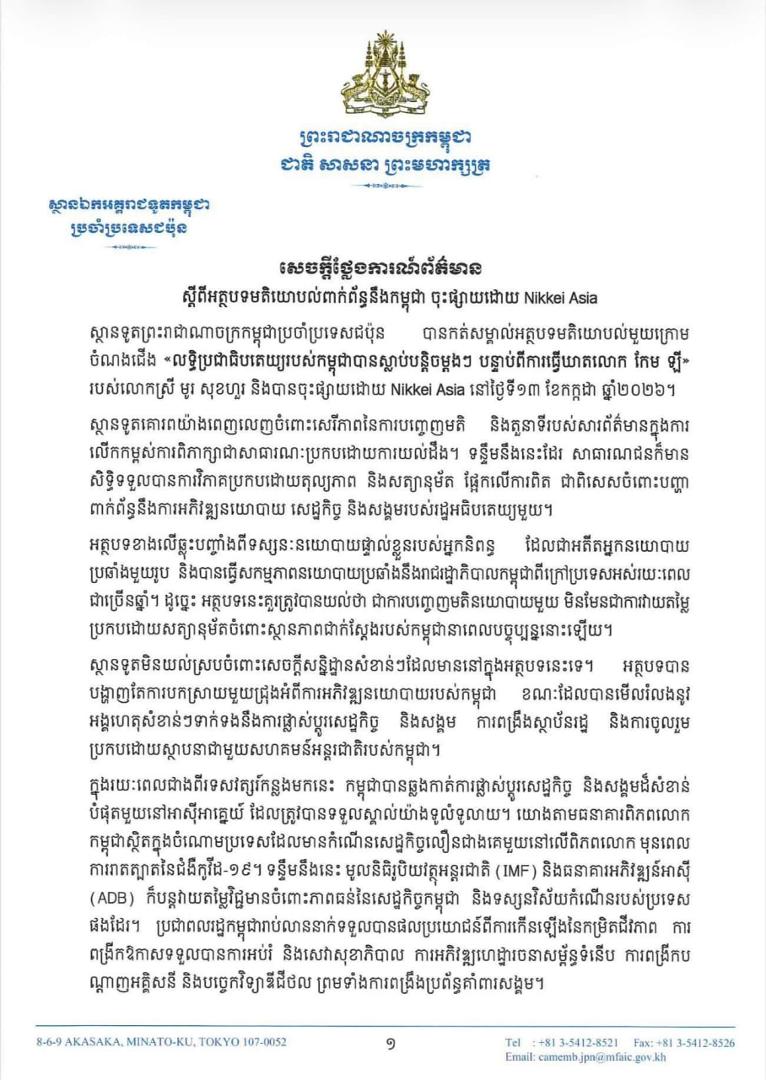
On July 13, Japan’s Nikkei Asia published an opinion piece by Mu Sochua titled “Cambodia’s democracy died slowly after Kem Ley’s murder.” Responding to it, the Cambodian Embassy in Japan said the article reflected the personal political views of its author, a former opposition politician who had lived abroad for years, and constituted political opinion rather than an objective assessment of Cambodia’s current realities.
In its press statement dated July 14, the Royal Embassy of Cambodia in Japan said it disagreed with the article’s main conclusions. It said the piece presented a one-sided interpretation of Cambodian political developments and overlooked important facts about socioeconomic transformation, stronger state institutions and constructive international engagement.
The statement said Cambodia had undergone one of Southeast Asia’s most significant socioeconomic transformations over more than two decades, an achievement widely recognised. Citing the World Bank, it said Cambodia had been among the world’s fastest-growing economies before COVID-19. It added that the International Monetary Fund (IMF) and Asian Development Bank (ADB) continued to assess Cambodia’s economic resilience and growth prospects positively. Millions of Cambodians, it said, had benefited from improved living standards, wider access to education and healthcare, modern infrastructure, expanded electricity and digital networks, and stronger social protection.
The statement said these achievements were not accidental, but resulted from preserving what Cambodians valued most after decades of war and conflict: peace, political stability, national reconciliation and people-centred development policies. It said these factors were an essential part of Cambodia’s present realities and should receive equal consideration alongside discussions of political challenges.
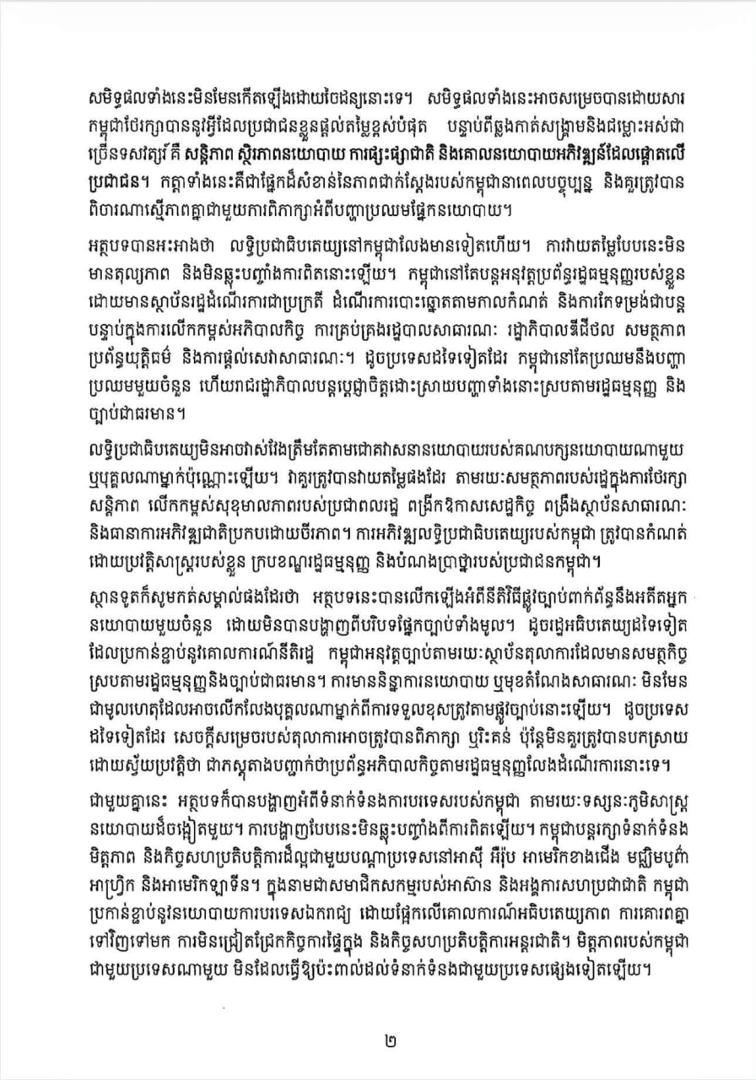
The article asserted that democracy no longer existed in Cambodia. The Cambodian Embassy in Japan described this assessment as unbalanced and inaccurate. It said Cambodia continued to operate its constitutional system, with functioning state institutions, regular elections and ongoing reforms to governance, public administration, digital government, judicial capacity and public services.
The Cambodian Embassy acknowledged that Cambodia, like other countries, continued to face challenges and said the Royal Government remained committed to addressing them in accordance with the Constitution and existing law. Democracy, it said, could not be measured solely by the political fortunes of any one party or individual.
Instead, it said democracy should also be assessed through the state’s ability to maintain peace, improve public welfare, expand economic opportunities, strengthen public institutions and ensure sustainable national development. Cambodia’s democratic development was shaped by its history, constitutional framework and people’s aspirations.
The embassy also said the article discussed legal proceedings involving some former politicians without presenting their full legal context. Like other sovereign states committed to the rule of law, Cambodia applied the law through competent judicial institutions in accordance with its Constitution and existing legislation. Political affiliation or public office did not exempt anyone from legal accountability. Court decisions could be discussed or criticised, it said, but should not automatically be interpreted as evidence that constitutional governance had ceased to function.
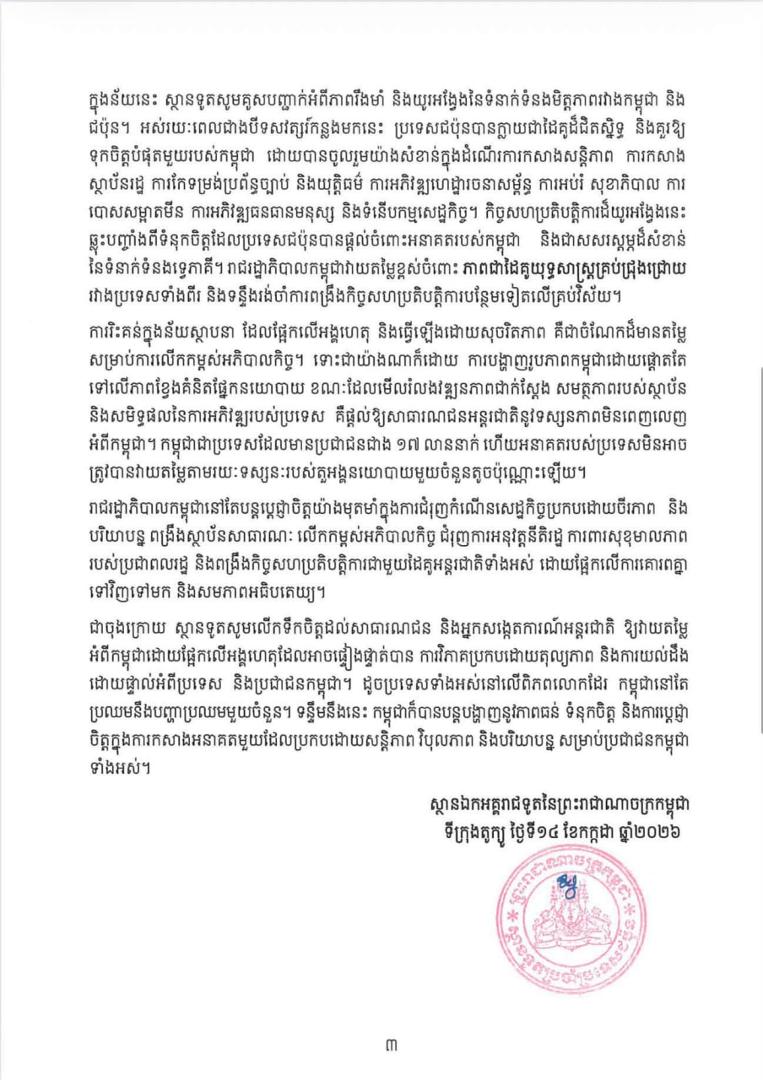
The embassy said the article also presented Cambodia’s foreign relations through a narrow geopolitical perspective that did not reflect reality. Cambodia continued friendly relations and cooperation with countries in Asia, Europe, North America, the Middle East, Africa and Latin America. As an active member of ASEAN and the United Nations, it pursued an independent foreign policy based on sovereignty, mutual respect, non-interference and international cooperation. Its friendship with any one country had never undermined its relations with others, the embassy said.
The Cambodian Embassy welcomed constructive criticism based on facts and offered in good faith. It said, however, that depicting the country solely through political disagreement while overlooking practical progress, institutional capacity and development achievements gave international audiences an incomplete picture. Cambodia had more than 17 million people, it said, and its future could not be judged only through the views of a small number of political actors.
The Royal Government remained firmly committed to sustainable and inclusive economic growth, stronger public institutions, improved governance, the rule of law, public welfare and cooperation with all international partners on the basis of mutual respect and sovereign equality, the statement said.
By: ង៉ែត ពិសាន្ត